HashMap是Java集合框架中最常用的Map实现,其设计精妙且性能优越。下面我将从数据结构、哈希算法、扩容机制、源码分析四个维度为你全面解析。
一、HashMap底层数据结构演进
📊 JDK 1.7 vs JDK 1.8 对比
| 特性 | JDK 1.7 | JDK 1.8 |
|---|---|---|
| 底层结构 | 数组 + 链表 | 数组 + 链表 + 红黑树 |
| 链表插入方式 | 头插法 | 尾插法 |
| 扩容时链表处理 | 重新计算hash | 保持原有顺序(高低位分离) |
| 并发问题 | 头插法导致死循环 | 尾插法避免死循环 |
| 性能优化 | 无 | 链表转红黑树(阈值8) |
🏗️ JDK 1.8 底层数据结构详解
java
public class HashMap<K,V> extends AbstractMap<K,V>
    implements Map<K,V>, Cloneable, Serializable {

    // 核心字段
    transient Node<K,V>[] table;          // 底层数组(哈希桶数组)
    transient int size;                    // 实际元素个数
    int threshold;                         // 扩容阈值(capacity * loadFactor)
    final float loadFactor;                // 负载因子(默认0.75)
    transient int modCount;                // 修改次数(fail-fast机制)

    // 链表节点
    static class Node<K,V> implements Map.Entry<K,V> {
        final int hash;        // key的hash值
        final K key;           // 键
        V value;               // 值
        Node<K,V> next;        // 指向下一个节点(链表)
    }

    // 红黑树节点(继承自LinkedHashMap.Entry)
    static final class TreeNode<K,V> extends LinkedHashMap.Entry<K,V> {
        TreeNode<K,V> parent;  // 父节点
        TreeNode<K,V> left;    // 左子节点
        TreeNode<K,V> right;   // 右子节点
        TreeNode<K,V> prev;    // 前驱节点
        boolean red;           // 颜色(红/黑)
    }
}
📐 数据结构图示
java
        +-----------------------------------+
        |       哈希桶数组 (table)          |
        +-----------------------------------+
        | index | 内容                       |
        +-------+----------------------------+
        |  0    |  null                      |
        |  1    |  Node(key1, value1)        |
        |  2    |  TreeNode(root)            | ← 红黑树(链表长度≥8)
        |       |    /        \              |
        |       |   T1        T2             |
        |  3    |  Node → Node → Node        | ← 链表(长度<8)
        |  4    |  null                      |
        |  ...  |  ...                       |
+-------+----------------------------+核心设计:
- 数组:快速定位桶位置(时间复杂度O(1))
- 链表:处理哈希冲突(同一桶位置的多个元素)
- 红黑树:当链表过长时转换,提升查询性能(时间复杂度O(log n))
二、哈希算法与索引计算
🔢 哈希值计算流程
java
// 1. 计算key的hashCode
int h = key.hashCode();

// 2. 扰动函数:高位参与运算,减少哈希冲突
h = h ^ (h >>> 16);

// 3. 计算数组索引(与运算代替取模,性能更高)
int index = h & (table.length - 1);
📊 扰动函数详解
java
static final int hash(Object key) {
    int h;
    return (key == null) ? 0 : (h = key.hashCode()) ^ (h >>> 16);
}
为什么需要扰动函数?
| 场景 | 无扰动函数 | 有扰动函数 |
|---|---|---|
| 哈希值 | 1111 1111 1111 1111 0000 0000 0000 0001 |
同左 |
| 数组长度-1 | 0000 0000 0000 0000 0000 1111 1111 1111 (1023) |
同左 |
| 与运算结果 | 0000 0000 0000 0000 0000 0000 0000 0001 |
0000 0000 0000 0000 0000 1111 1111 1110 |
| 问题 | 仅低位参与,冲突率高 | 高位也参与,分布更均匀 |
扰动函数的作用:将高位的特征"扰动"到低位,使哈希值分布更均匀,减少冲突。
🧪 哈希冲突示例
java
public class HashCollisionDemo {
    public static void main(String[] args) {
        HashMap<String, String> map = new HashMap<>();

        // 三个字符串的hashCode经过扰动后,可能落在同一桶
        String key1 = "Aa";
        String key2 = "BB";
        String key3 = "C#";

        System.out.println("key1 hashCode: " + key1.hashCode() + ", hash: " + hash(key1));
        System.out.println("key2 hashCode: " + key2.hashCode() + ", hash: " + hash(key2));
        System.out.println("key3 hashCode: " + key3.hashCode() + ", hash: " + hash(key3));

        map.put(key1, "Value1");
        map.put(key2, "Value2");
        map.put(key3, "Value3");

        // 这三个key可能落在同一个桶,形成链表
    }

    static int hash(Object key) {
        int h;
        return (key == null) ? 0 : (h = key.hashCode()) ^ (h >>> 16);
    }
}
三、put()方法完整流程(含时序图)
📊 put()方法时序图
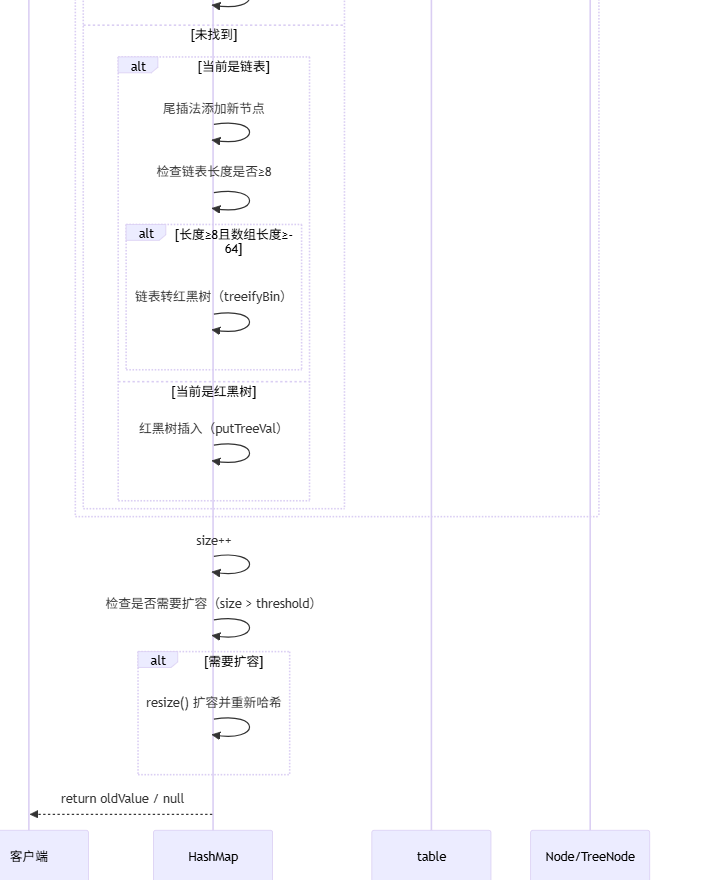
🔍 put()方法源码详解
java
public V put(K key, V value) {
    return putVal(hash(key), key, value, false, true);
}

final V putVal(int hash, K key, V value, boolean onlyIfAbsent,
               boolean evict) {
    Node<K,V>[] tab; Node<K,V> p; int n, i;

    // 1. 如果table为空或长度为0,调用resize()初始化
    if ((tab = table) == null || (n = tab.length) == 0)
        n = (tab = resize()).length;

    // 2. 计算桶索引,并检查该位置是否为空
    if ((p = tab[i = (n - 1) & hash]) == null)
        tab[i] = newNode(hash, key, value, null);  // 直接放入
    else {
        Node<K,V> e; K k;

        // 3. 检查第一个节点是否是目标key
        if (p.hash == hash &&
            ((k = p.key) == key || (key != null && key.equals(k))))
            e = p;
        // 4. 如果是红黑树节点,调用红黑树的put方法
        else if (p instanceof TreeNode)
            e = ((TreeNode<K,V>)p).putTreeVal(this, tab, hash, key, value);
        else {
            // 5. 遍历链表
            for (int binCount = 0; ; ++binCount) {
                if ((e = p.next) == null) {
                    // 尾插法添加新节点
                    p.next = newNode(hash, key, value, null);

                    // 检查是否需要转红黑树(阈值8)
                    if (binCount >= TREEIFY_THRESHOLD - 1) // -1 for 1st
                        treeifyBin(tab, hash);
                    break;
                }
                // 找到相同key,跳出循环
                if (e.hash == hash &&
                    ((k = e.key) == key || (key != null && key.equals(k))))
                    break;
                p = e;
            }
        }

        // 6. 如果找到相同key,替换value
        if (e != null) {
            V oldValue = e.value;
            if (!onlyIfAbsent || oldValue == null)
                e.value = value;
            afterNodeAccess(e);  // LinkedHashMap回调
            return oldValue;
        }
    }

    // 7. 修改次数+1(fail-fast)
    ++modCount;

    // 8. 检查是否需要扩容
    if (++size > threshold)
        resize();

    afterNodeInsertion(evict);  // LinkedHashMap回调
    return null;
}
四、扩容机制(resize)详解
📊 扩容时序图
🔍 resize()源码详解
java
final Node<K,V>[] resize() {
    Node<K,V>[] oldTab = table;
    int oldCap = (oldTab == null) ? 0 : oldTab.length;
    int oldThr = threshold;
    int newCap, newThr = 0;

    // ========== 第一阶段:计算新容量和新阈值 ==========
    if (oldCap > 0) {
        // 超过最大容量,不再扩容
        if (oldCap >= MAXIMUM_CAPACITY) {
            threshold = Integer.MAX_VALUE;
            return oldTab;
        }
        // 新容量 = 旧容量 * 2
        else if ((newCap = oldCap << 1) < MAXIMUM_CAPACITY &&
                 oldCap >= DEFAULT_INITIAL_CAPACITY)
            newThr = oldThr << 1; // 新阈值 = 旧阈值 * 2
    }
    else if (oldThr > 0) // initial capacity was placed in threshold
        newCap = oldThr;
    else {               // zero initial threshold signifies using defaults
        // 首次扩容:容量16,阈值12(16 * 0.75)
        newCap = DEFAULT_INITIAL_CAPACITY;
        newThr = (int)(DEFAULT_LOAD_FACTOR * DEFAULT_INITIAL_CAPACITY);
    }

    if (newThr == 0) {
        float ft = (float)newCap * loadFactor;
        newThr = (newCap < MAXIMUM_CAPACITY && ft < (float)MAXIMUM_CAPACITY ?
                  (int)ft : Integer.MAX_VALUE);
    }
    threshold = newThr;

    // ========== 第二阶段:创建新数组并迁移数据 ==========
    @SuppressWarnings({"rawtypes","unchecked"})
    Node<K,V>[] newTab = (Node<K,V>[])new Node[newCap];
    table = newTab;

    if (oldTab != null) {
        // 遍历旧数组
        for (int j = 0; j < oldCap; ++j) {
            Node<K,V> e;
            if ((e = oldTab[j]) != null) {
                oldTab[j] = null;  // 释放引用,便于GC

                // 情况1:桶中只有一个节点
                if (e.next == null)
                    newTab[e.hash & (newCap - 1)] = e;

                // 情况2:红黑树节点
                else if (e instanceof TreeNode)
                    ((TreeNode<K,V>)e).split(this, newTab, j, oldCap);

                // 情况3:链表节点(核心优化点)
                else {
                    // 高低位分离
                    Node<K,V> loHead = null, loTail = null;  // 低位链表(原索引)
                    Node<K,V> hiHead = null, hiTail = null;  // 高位链表(原索引+oldCap)
                    Node<K,V> next;

                    do {
                        next = e.next;
                        // 关键:判断是否需要移动到新位置
                        if ((e.hash & oldCap) == 0) {
                            // 低位:保持原索引
                            if (loTail == null)
                                loHead = e;
                            else
                                loTail.next = e;
                            loTail = e;
                        }
                        else {
                            // 高位:索引 + oldCap
                            if (hiTail == null)
                                hiHead = e;
                            else
                                hiTail.next = e;
                            hiTail = e;
                        }
                    } while ((e = next) != null);

                    // 放入新数组
                    if (loTail != null) {
                        loTail.next = null;
                        newTab[j] = loHead;  // 原索引位置
                    }
                    if (hiTail != null) {
                        hiTail.next = null;
                        newTab[j + oldCap] = hiHead;  // 原索引 + oldCap
                    }
                }
            }
        }
    }
    return newTab;
}
📐 高低位分离原理图解
假设:
- 旧容量:16(二进制
0001 0000) - 新容量:32(二进制
0010 0000) - 哈希值:
0101 0101
java
旧索引计算:hash & (16-1) = 0101 0101 & 0000 1111 = 0101 (5)

扩容后索引计算有两种可能:
1. 保持原索引:0101 0101 & 0001 1111 = 0101 (5)
2. 原索引 + oldCap:0101 0101 & 0001 1111 = 10101 (21)

判断条件:hash & oldCap
- 如果 (hash & 16) == 0 → 保持原索引(低位)
- 如果 (hash & 16) != 0 → 原索引 + 16(高位)

示例:
hash1 = 0000 0101 → & 0001 0000 = 0 → 低位 → 索引5
hash2 = 0001 0101 → & 0001 0000 = 1 → 高位 → 索引21优势:
- 无需重新计算hash
- 保持链表原有顺序(避免JDK 1.7头插法的死循环问题)
- 时间复杂度O(n),每个节点只需判断一次
五、链表转红黑树机制
📊 转换阈值
| 操作 | 阈值 | 说明 |
|---|---|---|
| 链表→红黑树 | 8 | 链表长度≥8且数组长度≥64 |
| 红黑树→链表 | 6 | 红黑树节点数≤6 |
java
// 阈值常量
static final int TREEIFY_THRESHOLD = 8;   // 链表转树阈值
static final int UNTREEIFY_THRESHOLD = 6; // 树转链表阈值
static final int MIN_TREEIFY_CAPACITY = 64; // 转树最小数组容量
🔍 链表转红黑树流程
java
final void treeifyBin(Node<K,V>[] tab, int hash) {
    int n, index; Node<K,V> e;

    // 优化:如果数组长度小于64,优先扩容而不是转树
    if (tab == null || (n = tab.length) < MIN_TREEIFY_CAPACITY)
        resize();
    else if ((e = tab[index = (n - 1) & hash]) != null) {
        TreeNode<K,V> hd = null, tl = null;

        // 1. 将链表节点转换为TreeNode
        do {
            TreeNode<K,V> p = replacementTreeNode(e, null);
            if (tl == null)
                hd = p;
            else {
                p.prev = tl;
                tl.next = p;
            }
            tl = p;
        } while ((e = e.next) != null);

        // 2. 构建红黑树
        if ((tab[index] = hd) != null)
            hd.treeify(tab);
    }
}
📐 红黑树结构示例
java
        桶索引:5
        +-------------------+
        |   红黑树根节点    |
        |      (key50)      |
        +---------+---------+
                  |
        +---------+---------+
        |                   |
    (key30)红           (key70)黑
      /   \               /   \
(key20) (key40) (key60) (key80)红黑树特性:
- 查询时间复杂度:O(log n)
- 插入/删除时间复杂度:O(log n)
- 相比链表(O(n)),在数据量大时性能显著提升
六、get()方法流程
java
public V get(Object key) {
    Node<K,V> e;
    return (e = getNode(hash(key), key)) == null ? null : e.value;
}

final Node<K,V> getNode(int hash, Object key) {
    Node<K,V>[] tab; Node<K,V> first, e; int n; K k;

    // 1. 检查table是否为空,桶是否为空
    if ((tab = table) != null && (n = tab.length) > 0 &&
        (first = tab[(n - 1) & hash]) != null) {

        // 2. 检查第一个节点
        if (first.hash == hash &&
            ((k = first.key) == key || (key != null && key.equals(k))))
            return first;

        // 3. 遍历后续节点
        if ((e = first.next) != null) {
            // 3.1 红黑树
            if (first instanceof TreeNode)
                return ((TreeNode<K,V>)first).getTreeNode(hash, key);

            // 3.2 链表
            do {
                if (e.hash == hash &&
                    ((k = e.key) == key || (key != null && key.equals(k))))
                    return e;
            } while ((e = e.next) != null);
        }
    }
    return null;
}
七、性能分析与最佳实践
负载因子影响
java
// 负载因子对比
HashMap<String, String> map1 = new HashMap<>(16, 0.5f);  // 容量8时扩容
HashMap<String, String> map2 = new HashMap<>(16, 0.75f); // 容量12时扩容(默认)
HashMap<String, String> map3 = new HashMap<>(16, 1.0f); // 容量16时扩容| 负载因子 | 扩容频率 | 空间利用率 | 哈希冲突概率 |
|---|---|---|---|
| 0.5 | 高 | 低 | 低 |
| 0.75 | 中 | 中 | 中(默认推荐) |
| 1.0 | 低 | 高 | 高 |
✅ 最佳实践
1. 预估容量,避免频繁扩容
java
// ❌ 不推荐:未知容量,频繁扩容
Map<String, User> userMap = new HashMap<>();
for (User user : userList) {
    userMap.put(user.getId(), user);
}

// ✅ 推荐:预估容量
// 公式:expectedSize / loadFactor + 1
int initialCapacity = (int) (userList.size() / 0.75f) + 1;
Map<String, User> userMap = new HashMap<>(initialCapacity);
for (User user : userList) {
    userMap.put(user.getId(), user);
}
2. 使用合适的负载因子
java
// 空间敏感场景:降低负载因子
Map<String, String> cache = new HashMap<>(1024, 0.5f);

// 查询频繁场景:保持默认0.75
Map<String, String> config = new HashMap<>();
3. 避免使用可变对象作为key
java
// ❌ 危险:修改key的hashCode会导致无法找到
class BadKey {
    private String name;
    // 有setter方法,hashCode可能改变
}

// ✅ 推荐:使用不可变对象
class GoodKey {
    private final String id;
    // 无setter,hashCode不变
}
4. 重写equals和hashCode
java
public class User {
    private String id;
    private String name;

    @Override
    public int hashCode() {
        return Objects.hash(id);  // 只用id计算
    }

    @Override
    public boolean equals(Object obj) {
        if (this == obj) return true;
        if (!(obj instanceof User)) return false;
        User other = (User) obj;
        return Objects.equals(id, other.id);
    }
}
八、HashMap vs Hashtable vs ConcurrentHashMap
| 特性 | HashMap | Hashtable | ConcurrentHashMap |
|---|---|---|---|
| 线程安全 | ❌ 否 | ✅ 是(synchronized) | ✅ 是(CAS + synchronized) |
| null键/值 | ✅ 支持 | ❌ 不支持 | ✅ 支持(JDK 1.8) |
| 底层结构 | 数组+链表+红黑树 | 数组+链表 | 数组+链表+红黑树 |
| 扩容机制 | 2倍扩容 | 2倍扩容 | 2倍扩容 |
| 性能 | 高 | 低(全表锁) | 高(分段锁/CAS) |
| 推荐使用 | 单线程 | 不推荐 | 多线程 |
九、总结:核心要点
🔑 核心机制总结
| 机制 | 关键点 | 作用 |
|---|---|---|
| 哈希算法 | 扰动函数 h ^ (h >>> 16) |
减少哈希冲突 |
| 索引计算 | (n-1) & hash |
快速定位桶位置 |
| 扩容机制 | 2倍扩容 + 高低位分离 | 保持链表顺序,避免死循环 |
| 链表转树 | 长度≥8且容量≥64 | 提升查询性能 |
| 负载因子 | 默认0.75 | 平衡空间与时间 |