💡💡💡本专栏所有程序均经过测试,可成功执行💡💡💡
本文给大家带来的教程是将YOLO26的主干网络替换为RMT 来提取特征 。文章在介绍主要的原理后,将手把手教学如何进行模块的代码添加和修改 ,并将修改后的完整代码 放在文章的最后,方便大家一键运行,小白也可轻松上手实践。以帮助您更好地学习深度学习目标检测YOLO系列的挑战。
专栏地址:YOLO26改进-论文涨点------点击跳转看所有内容,关注不迷路!****
目录
[2. RMT代码实现](#2. RMT代码实现)
[2.1 将RMT添加到YOLO26中](#2.1 将RMT添加到YOLO26中)
[2.2 更改init.py文件](#2.2 更改init.py文件)
[2.3 添加yaml文件](#2.3 添加yaml文件)
[2.4 在task.py中进行注册](#2.4 在task.py中进行注册)
[2.5 执行程序](#2.5 执行程序)
[3. 完整代码分享](#3. 完整代码分享)
[4. GFLOPs](#4. GFLOPs)
[5. 进阶](#5. 进阶)
1.论文
论文地址: RMT:Retentive Networks Meet Vision Transformers
官方代码: 官方代码仓库点击即可跳转
2. RMT代码实现
2.1 将RMT添加到YOLO26中
**关键步骤一:**在ultralytics\ultralytics\nn\modules下面新建文件夹models,在文件夹下新建RMT.py,粘贴下面代码
python
import torch
import torch.nn as nn
from torch.nn.common_types import _size_2_t
import torch.utils.checkpoint as checkpoint
from timm.models.layers import DropPath, to_2tuple, trunc_normal_

import math
import torch
import torch.nn.functional as F
import torch.nn as nn
from timm.models.layers import DropPath, trunc_normal_
from timm.models.vision_transformer import VisionTransformer
from timm.models.registry import register_model
from timm.models.vision_transformer import _cfg
from typing import Tuple, Union
from functools import partial

__all__ = ['RMT_T', 'RMT_S', 'RMT_B', 'RMT_L']

class DWConv2d(nn.Module):

    def __init__(self, dim, kernel_size, stride, padding):
        super().__init__()
        self.conv = nn.Conv2d(dim, dim, kernel_size, stride, padding, groups=dim)

    def forward(self, x: torch.Tensor):
        '''
        x: (b h w c)
        '''
        x = x.permute(0, 3, 1, 2) #(b c h w)
        x = self.conv(x) #(b c h w)
        x = x.permute(0, 2, 3, 1) #(b h w c)
        return x


class RelPos2d(nn.Module):

    def __init__(self, embed_dim, num_heads, initial_value, heads_range):
        '''
        recurrent_chunk_size: (clh clw)
        num_chunks: (nch ncw)
        clh * clw == cl
        nch * ncw == nc

        default: clh==clw, clh != clw is not implemented
        '''
        super().__init__()
        angle = 1.0 / (10000 ** torch.linspace(0, 1, embed_dim // num_heads // 2))
        angle = angle.unsqueeze(-1).repeat(1, 2).flatten()
        self.initial_value = initial_value
        self.heads_range = heads_range
        self.num_heads = num_heads
        decay = torch.log(1 - 2 ** (-initial_value - heads_range * torch.arange(num_heads, dtype=torch.float) / num_heads))
        self.register_buffer('angle', angle)
        self.register_buffer('decay', decay)

    def generate_2d_decay(self, H: int, W: int):
        '''
        generate 2d decay mask, the result is (HW)*(HW)
        '''
        index_h = torch.arange(H).to(self.decay)
        index_w = torch.arange(W).to(self.decay)
        grid = torch.meshgrid([index_h, index_w])
        grid = torch.stack(grid, dim=-1).reshape(H*W, 2) #(H*W 2)
        mask = grid[:, None, :] - grid[None, :, :] #(H*W H*W 2)
        mask = (mask.abs()).sum(dim=-1)
        mask = mask * self.decay[:, None, None]  #(n H*W H*W)
        return mask

    def generate_1d_decay(self, l: int):
        '''
        generate 1d decay mask, the result is l*l
        '''
        index = torch.arange(l).to(self.decay)
        mask = index[:, None] - index[None, :] #(l l)
        mask = mask.abs() #(l l)
        mask = mask * self.decay[:, None, None]  #(n l l)
        return mask

    def forward(self, slen: Tuple[int], activate_recurrent=False, chunkwise_recurrent=False):
        '''
        slen: (h, w)
        h * w == l
        recurrent is not implemented
        '''
        if activate_recurrent:

            retention_rel_pos = self.decay.exp()

        elif chunkwise_recurrent:
            mask_h = self.generate_1d_decay(slen[0])
            mask_w = self.generate_1d_decay(slen[1])

            retention_rel_pos = (mask_h, mask_w)

        else:
            mask = self.generate_2d_decay(slen[0], slen[1]) #(n l l)
            retention_rel_pos = mask

        return retention_rel_pos

class MaSAd(nn.Module):

    def __init__(self, embed_dim, num_heads, value_factor=1):
        super().__init__()
        self.factor = value_factor
        self.embed_dim = embed_dim
        self.num_heads = num_heads
        self.head_dim = self.embed_dim * self.factor // num_heads
        self.key_dim = self.embed_dim // num_heads
        self.scaling = self.key_dim ** -0.5
        self.q_proj = nn.Linear(embed_dim, embed_dim, bias=True)
        self.k_proj = nn.Linear(embed_dim, embed_dim, bias=True)
        self.v_proj = nn.Linear(embed_dim, embed_dim * self.factor, bias=True)
        self.lepe = DWConv2d(embed_dim, 5, 1, 2)


        self.out_proj = nn.Linear(embed_dim*self.factor, embed_dim, bias=True)
        self.reset_parameters()

    def reset_parameters(self):
        nn.init.xavier_normal_(self.q_proj.weight, gain=2 ** -2.5)
        nn.init.xavier_normal_(self.k_proj.weight, gain=2 ** -2.5)
        nn.init.xavier_normal_(self.v_proj.weight, gain=2 ** -2.5)
        nn.init.xavier_normal_(self.out_proj.weight)
        nn.init.constant_(self.out_proj.bias, 0.0)

    def forward(self, x: torch.Tensor, rel_pos, chunkwise_recurrent=False, incremental_state=None):
        '''
        x: (b h w c)
        mask_h: (n h h)
        mask_w: (n w w)
        '''
        bsz, h, w, _ = x.size()

        mask_h, mask_w = rel_pos

        q = self.q_proj(x)
        k = self.k_proj(x)
        v = self.v_proj(x)
        lepe = self.lepe(v)

        k *= self.scaling
        qr = q.view(bsz, h, w, self.num_heads, self.key_dim).permute(0, 3, 1, 2, 4) #(b n h w d1)
        kr = k.view(bsz, h, w, self.num_heads, self.key_dim).permute(0, 3, 1, 2, 4) #(b n h w d1)


        '''
        qr: (b n h w d1)
        kr: (b n h w d1)
        v: (b h w n*d2)
        '''

        qr_w = qr.transpose(1, 2) #(b h n w d1)
        kr_w = kr.transpose(1, 2) #(b h n w d1)
        v = v.reshape(bsz, h, w, self.num_heads, -1).permute(0, 1, 3, 2, 4) #(b h n w d2)

        qk_mat_w = qr_w @ kr_w.transpose(-1, -2) #(b h n w w)
        qk_mat_w = qk_mat_w + mask_w  #(b h n w w)
        qk_mat_w = torch.softmax(qk_mat_w, -1) #(b h n w w)
        v = torch.matmul(qk_mat_w, v) #(b h n w d2)


        qr_h = qr.permute(0, 3, 1, 2, 4) #(b w n h d1)
        kr_h = kr.permute(0, 3, 1, 2, 4) #(b w n h d1)
        v = v.permute(0, 3, 2, 1, 4) #(b w n h d2)

        qk_mat_h = qr_h @ kr_h.transpose(-1, -2) #(b w n h h)
        qk_mat_h = qk_mat_h + mask_h  #(b w n h h)
        qk_mat_h = torch.softmax(qk_mat_h, -1) #(b w n h h)
        output = torch.matmul(qk_mat_h, v) #(b w n h d2)

        output = output.permute(0, 3, 1, 2, 4).flatten(-2, -1) #(b h w n*d2)
        output = output + lepe
        output = self.out_proj(output)
        return output

class MaSA(nn.Module):

    def __init__(self, embed_dim, num_heads, value_factor=1):
        super().__init__()
        self.factor = value_factor
        self.embed_dim = embed_dim
        self.num_heads = num_heads
        self.head_dim = self.embed_dim * self.factor // num_heads
        self.key_dim = self.embed_dim // num_heads
        self.scaling = self.key_dim ** -0.5
        self.q_proj = nn.Linear(embed_dim, embed_dim, bias=True)
        self.k_proj = nn.Linear(embed_dim, embed_dim, bias=True)
        self.v_proj = nn.Linear(embed_dim, embed_dim * self.factor, bias=True)
        self.lepe = DWConv2d(embed_dim, 5, 1, 2)
        self.out_proj = nn.Linear(embed_dim*self.factor, embed_dim, bias=True)
        self.reset_parameters()

    def reset_parameters(self):
        nn.init.xavier_normal_(self.q_proj.weight, gain=2 ** -2.5)
        nn.init.xavier_normal_(self.k_proj.weight, gain=2 ** -2.5)
        nn.init.xavier_normal_(self.v_proj.weight, gain=2 ** -2.5)
        nn.init.xavier_normal_(self.out_proj.weight)
        nn.init.constant_(self.out_proj.bias, 0.0)

    def forward(self, x: torch.Tensor, rel_pos, chunkwise_recurrent=False, incremental_state=None):
        '''
        x: (b h w c)
        rel_pos: mask: (n l l)
        '''
        bsz, h, w, _ = x.size()
        mask = rel_pos

        assert h*w == mask.size(1)

        q = self.q_proj(x)
        k = self.k_proj(x)
        v = self.v_proj(x)
        lepe = self.lepe(v)

        k *= self.scaling
        qr = q.view(bsz, h, w, self.num_heads, -1).permute(0, 3, 1, 2, 4) #(b n h w d1)
        kr = k.view(bsz, h, w, self.num_heads, -1).permute(0, 3, 1, 2, 4) #(b n h w d1)


        qr = qr.flatten(2, 3) #(b n l d1)
        kr = kr.flatten(2, 3) #(b n l d1)
        vr = v.reshape(bsz, h, w, self.num_heads, -1).permute(0, 3, 1, 2, 4) #(b n h w d2)
        vr = vr.flatten(2, 3) #(b n l d2)
        qk_mat = qr @ kr.transpose(-1, -2) #(b n l l)
        qk_mat = qk_mat + mask  #(b n l l)
        qk_mat = torch.softmax(qk_mat, -1) #(b n l l)
        output = torch.matmul(qk_mat, vr) #(b n l d2)
        output = output.transpose(1, 2).reshape(bsz, h, w, -1) #(b h w n*d2)
        output = output + lepe
        output = self.out_proj(output)
        return output

class FeedForwardNetwork(nn.Module):
    def __init__(
        self,
        embed_dim,
        ffn_dim,
        activation_fn=F.gelu,
        dropout=0.0,
        activation_dropout=0.0,
        layernorm_eps=1e-6,
        subln=False,
        subconv=False
        ):
        super().__init__()
        self.embed_dim = embed_dim
        self.activation_fn = activation_fn
        self.activation_dropout_module = torch.nn.Dropout(activation_dropout)
        self.dropout_module = torch.nn.Dropout(dropout)
        self.fc1 = nn.Linear(self.embed_dim, ffn_dim)
        self.fc2 = nn.Linear(ffn_dim, self.embed_dim)
        self.ffn_layernorm = nn.LayerNorm(ffn_dim, eps=layernorm_eps) if subln else None
        self.dwconv = DWConv2d(ffn_dim, 3, 1, 1) if subconv else None

    def reset_parameters(self):
        self.fc1.reset_parameters()
        self.fc2.reset_parameters()
        if self.ffn_layernorm is not None:
            self.ffn_layernorm.reset_parameters()

    def forward(self, x: torch.Tensor):
        '''
        x: (b h w c)
        '''
        x = self.fc1(x)
        x = self.activation_fn(x)
        x = self.activation_dropout_module(x)
        if self.dwconv is not None:
            residual = x
            x = self.dwconv(x)
            x = x + residual
        if self.ffn_layernorm is not None:
            x = self.ffn_layernorm(x)
        x = self.fc2(x)
        x = self.dropout_module(x)
        return x

class RetBlock(nn.Module):
    def __init__(self, retention: str, embed_dim: int, num_heads: int, ffn_dim: int, drop_path=0., layerscale=False, layer_init_values=1e-5):
        super().__init__()
        self.layerscale = layerscale
        self.embed_dim = embed_dim
        self.retention_layer_norm = nn.LayerNorm(self.embed_dim, eps=1e-6)
        assert retention in ['chunk', 'whole']
        if retention == 'chunk':
            self.retention = MaSAd(embed_dim, num_heads)
        else:
            self.retention = MaSA(embed_dim, num_heads)
        self.drop_path = DropPath(drop_path)
        self.final_layer_norm = nn.LayerNorm(self.embed_dim, eps=1e-6)
        self.ffn = FeedForwardNetwork(embed_dim, ffn_dim)
        self.pos = DWConv2d(embed_dim, 3, 1, 1)

        if layerscale:
            self.gamma_1 = nn.Parameter(layer_init_values * torch.ones(1, 1, 1, embed_dim),requires_grad=True)
            self.gamma_2 = nn.Parameter(layer_init_values * torch.ones(1, 1, 1, embed_dim),requires_grad=True)

    def forward(
            self,
            x: torch.Tensor,
            incremental_state=None,
            chunkwise_recurrent=False,
            retention_rel_pos=None
        ):
        x = x + self.pos(x)
        if self.layerscale:
            x = x + self.drop_path(self.gamma_1 * self.retention(self.retention_layer_norm(x), retention_rel_pos, chunkwise_recurrent, incremental_state))
            x = x + self.drop_path(self.gamma_2 * self.ffn(self.final_layer_norm(x)))
        else:
            x = x + self.drop_path(self.retention(self.retention_layer_norm(x), retention_rel_pos, chunkwise_recurrent, incremental_state))
            x = x + self.drop_path(self.ffn(self.final_layer_norm(x)))
        return x

class PatchMerging(nn.Module):
    r""" Patch Merging Layer.

    Args:
        input_resolution (tuple[int]): Resolution of input feature.
        dim (int): Number of input channels.
        norm_layer (nn.Module, optional): Normalization layer.  Default: nn.LayerNorm
    """
    def __init__(self, dim, out_dim, norm_layer=nn.LayerNorm):
        super().__init__()
        self.dim = dim
        self.reduction = nn.Conv2d(dim, out_dim, 3, 2, 1)
        self.norm = nn.BatchNorm2d(out_dim)

    def forward(self, x):
        '''
        x: B H W C
        '''
        x = x.permute(0, 3, 1, 2).contiguous()  #(b c h w)
        x = self.reduction(x) #(b oc oh ow)
        x = self.norm(x)
        x = x.permute(0, 2, 3, 1) #(b oh ow oc)
        return x

class BasicLayer(nn.Module):
    """ A basic Swin Transformer layer for one stage.

    Args:
        dim (int): Number of input channels.
        input_resolution (tuple[int]): Input resolution.
        depth (int): Number of blocks.
        num_heads (int): Number of attention heads.
        window_size (int): Local window size.
        mlp_ratio (float): Ratio of mlp hidden dim to embedding dim.
        qkv_bias (bool, optional): If True, add a learnable bias to query, key, value. Default: True
        qk_scale (float | None, optional): Override default qk scale of head_dim ** -0.5 if set.
        drop (float, optional): Dropout rate. Default: 0.0
        attn_drop (float, optional): Attention dropout rate. Default: 0.0
        drop_path (float | tuple[float], optional): Stochastic depth rate. Default: 0.0
        norm_layer (nn.Module, optional): Normalization layer. Default: nn.LayerNorm
        downsample (nn.Module | None, optional): Downsample layer at the end of the layer. Default: None
        use_checkpoint (bool): Whether to use checkpointing to save memory. Default: False.
        fused_window_process (bool, optional): If True, use one kernel to fused window shift & window partition for acceleration, similar for the reversed part. Default: False
    """

    def __init__(self, embed_dim, out_dim, depth, num_heads,
                 init_value: float, heads_range: float,
                 ffn_dim=96., drop_path=0., norm_layer=nn.LayerNorm, chunkwise_recurrent=False,
                 downsample: PatchMerging=None, use_checkpoint=False,
                 layerscale=False, layer_init_values=1e-5):

        super().__init__()
        self.embed_dim = embed_dim
        self.depth = depth
        self.use_checkpoint = use_checkpoint
        self.chunkwise_recurrent = chunkwise_recurrent
        if chunkwise_recurrent:
            flag = 'chunk'
        else:
            flag = 'whole'
        self.Relpos = RelPos2d(embed_dim, num_heads, init_value, heads_range)

        # build blocks
        self.blocks = nn.ModuleList([
            RetBlock(flag, embed_dim, num_heads, ffn_dim,
                     drop_path[i] if isinstance(drop_path, list) else drop_path, layerscale, layer_init_values)
            for i in range(depth)])

        # patch merging layer
        if downsample is not None:
            self.downsample = downsample(dim=embed_dim, out_dim=out_dim, norm_layer=norm_layer)
        else:
            self.downsample = None

    def forward(self, x):
        b, h, w, d = x.size()
        rel_pos = self.Relpos((h, w), chunkwise_recurrent=self.chunkwise_recurrent)
        for blk in self.blocks:
            if self.use_checkpoint:
                tmp_blk = partial(blk, incremental_state=None, chunkwise_recurrent=self.chunkwise_recurrent, retention_rel_pos=rel_pos)
                x = checkpoint.checkpoint(tmp_blk, x)
            else:
                x = blk(x, incremental_state=None, chunkwise_recurrent=self.chunkwise_recurrent, retention_rel_pos=rel_pos)
        if self.downsample is not None:
            x = self.downsample(x)
        return x

class LayerNorm2d(nn.Module):
    def __init__(self, dim):
        super().__init__()
        self.norm = nn.LayerNorm(dim, eps=1e-6)

    def forward(self, x: torch.Tensor):
        '''
        x: (b c h w)
        '''
        x = x.permute(0, 2, 3, 1).contiguous() #(b h w c)
        x = self.norm(x) #(b h w c)
        x = x.permute(0, 3, 1, 2).contiguous()
        return x

class PatchEmbed(nn.Module):
    r""" Image to Patch Embedding

    Args:
        img_size (int): Image size.  Default: 224.
        patch_size (int): Patch token size. Default: 4.
        in_chans (int): Number of input image channels. Default: 3.
        embed_dim (int): Number of linear projection output channels. Default: 96.
        norm_layer (nn.Module, optional): Normalization layer. Default: None
    """

    def __init__(self, in_chans=3, embed_dim=96, norm_layer=None):
        super().__init__()
        self.in_chans = in_chans
        self.embed_dim = embed_dim

        self.proj = nn.Sequential(
            nn.Conv2d(in_chans, embed_dim//2, 3, 2, 1),
            nn.BatchNorm2d(embed_dim//2),
            nn.GELU(),
            nn.Conv2d(embed_dim//2, embed_dim//2, 3, 1, 1),
            nn.BatchNorm2d(embed_dim//2),
            nn.GELU(),
            nn.Conv2d(embed_dim//2, embed_dim, 3, 2, 1),
            nn.BatchNorm2d(embed_dim),
            nn.GELU(),
            nn.Conv2d(embed_dim, embed_dim, 3, 1, 1),
            nn.BatchNorm2d(embed_dim)
        )

    def forward(self, x):
        B, C, H, W = x.shape
        x = self.proj(x).permute(0, 2, 3, 1) #(b h w c)
        return x

class VisRetNet(nn.Module):

    def __init__(self, in_chans=3, num_classes=1000,
                 embed_dims=[96, 192, 384, 768], depths=[2, 2, 6, 2], num_heads=[3, 6, 12, 24],
                 init_values=[1, 1, 1, 1], heads_ranges=[3, 3, 3, 3], mlp_ratios=[3, 3, 3, 3], drop_path_rate=0.1, norm_layer=nn.LayerNorm,
                 patch_norm=True, use_checkpoints=[False, False, False, False], chunkwise_recurrents=[True, True, False, False],
                 layerscales=[False, False, False, False], layer_init_values=1e-6):
        super().__init__()

        self.num_classes = num_classes
        self.num_layers = len(depths)
        self.embed_dim = embed_dims[0]
        self.patch_norm = patch_norm
        self.num_features = embed_dims[-1]
        self.mlp_ratios = mlp_ratios

        # split image into non-overlapping patches
        self.patch_embed = PatchEmbed(in_chans=in_chans, embed_dim=embed_dims[0],
            norm_layer=norm_layer if self.patch_norm else None)


        # stochastic depth
        dpr = [x.item() for x in torch.linspace(0, drop_path_rate, sum(depths))]  # stochastic depth decay rule

        # build layers
        self.layers = nn.ModuleList()
        for i_layer in range(self.num_layers):
            layer = BasicLayer(
                embed_dim=embed_dims[i_layer],
                out_dim=embed_dims[i_layer+1] if (i_layer < self.num_layers - 1) else None,
                depth=depths[i_layer],
                num_heads=num_heads[i_layer],
                init_value=init_values[i_layer],
                heads_range=heads_ranges[i_layer],
                ffn_dim=int(mlp_ratios[i_layer]*embed_dims[i_layer]),
                drop_path=dpr[sum(depths[:i_layer]):sum(depths[:i_layer + 1])],
                norm_layer=norm_layer,
                chunkwise_recurrent=chunkwise_recurrents[i_layer],
                downsample=PatchMerging if (i_layer < self.num_layers - 1) else None,
                use_checkpoint=use_checkpoints[i_layer],
                layerscale=layerscales[i_layer],
                layer_init_values=layer_init_values
            )
            self.layers.append(layer)

        self.width_list = [i.size(1) for i in self.forward(torch.randn(1, 3, 640, 640))]
        self.apply(self._init_weights)

    def _init_weights(self, m):
        if isinstance(m, nn.Linear):
            trunc_normal_(m.weight, std=.02)
            if isinstance(m, nn.Linear) and m.bias is not None:
                nn.init.constant_(m.bias, 0)
        elif isinstance(m, nn.LayerNorm):
            try:
                nn.init.constant_(m.bias, 0)
                nn.init.constant_(m.weight, 1.0)
            except:
                pass

    @torch.jit.ignore
    def no_weight_decay(self):
        return {'absolute_pos_embed'}

    @torch.jit.ignore
    def no_weight_decay_keywords(self):
        return {'relative_position_bias_table'}

    def forward(self, x):
        input_size = x.size(2)
        scale = [4, 8, 16, 32]
        features = [None, None, None, None]
        x = self.patch_embed(x)
        if input_size // x.size(2) in scale:
            features[scale.index(input_size // x.size(2))] = x.permute(0, 3, 1, 2)
        for layer in self.layers:
            x = layer(x)
            if input_size // x.size(2) in scale:
                features[scale.index(input_size // x.size(2))] = x.permute(0, 3, 1, 2)

        return features

def RMT_T():
    model = VisRetNet(
        embed_dims=[64, 128, 256, 512],
        depths=[2, 2, 8, 2],
        num_heads=[4, 4, 8, 16],
        init_values=[2, 2, 2, 2],
        heads_ranges=[4, 4, 6, 6],
        mlp_ratios=[3, 3, 3, 3],
        drop_path_rate=0.1,
        chunkwise_recurrents=[True, True, False, False],
        layerscales=[False, False, False, False]
    )
    model.default_cfg = _cfg()
    return model

def RMT_S():
    model = VisRetNet(
        embed_dims=[64, 128, 256, 512],
        depths=[3, 4, 18, 4],
        num_heads=[4, 4, 8, 16],
        init_values=[2, 2, 2, 2],
        heads_ranges=[4, 4, 6, 6],
        mlp_ratios=[4, 4, 3, 3],
        drop_path_rate=0.15,
        chunkwise_recurrents=[True, True, True, False],
        layerscales=[False, False, False, False]
    )
    model.default_cfg = _cfg()
    return model

def RMT_B():
    model = VisRetNet(
        embed_dims=[80, 160, 320, 512],
        depths=[4, 8, 25, 8],
        num_heads=[5, 5, 10, 16],
        init_values=[2, 2, 2, 2],
        heads_ranges=[5, 5, 6, 6],
        mlp_ratios=[4, 4, 3, 3],
        drop_path_rate=0.4,
        chunkwise_recurrents=[True, True, True, False],
        layerscales=[False, False, True, True],
        layer_init_values=1e-6
    )
    model.default_cfg = _cfg()
    return model

def RMT_L():
    model = VisRetNet(
        embed_dims=[112, 224, 448, 640],
        depths=[4, 8, 25, 8],
        num_heads=[7, 7, 14, 20],
        init_values=[2, 2, 2, 2],
        heads_ranges=[6, 6, 6, 6],
        mlp_ratios=[4, 4, 3, 3],
        drop_path_rate=0.5,
        chunkwise_recurrents=[True, True, True, False],
        layerscales=[False, False, True, True],
        layer_init_values=1e-6
    )
    model.default_cfg = _cfg()
    return model
2.2 更改init.py文件
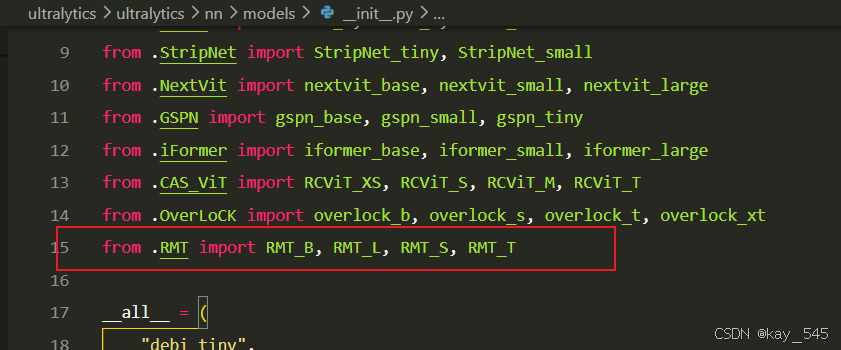
**关键步骤二:**在文件ultralytics\ultralytics\nn\modules\models文件夹下新建__init__.py文件,先导入函数
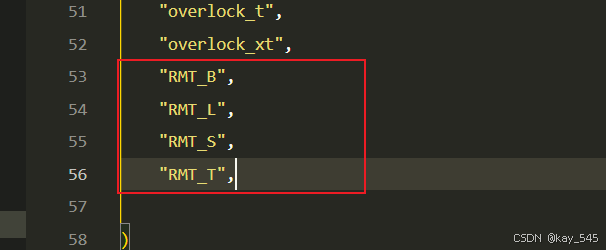
然后在下面的__all__中声明函数
2.3 添加yaml文件
**关键步骤三:**在/ultralytics/ultralytics/cfg/models/26下面新建文件yolo26_RMT.yaml文件,粘贴下面的内容
- 目标检测
python
# Ultralytics 🚀 AGPL-3.0 License - https://ultralytics.com/license

# Ultralytics YOLO26 object detection model with P3/8 - P5/32 outputs
# Model docs: https://docs.ultralytics.com/models/yolo26
# Task docs: https://docs.ultralytics.com/tasks/detect

# Parameters
nc: 80 # number of classes
end2end: True # whether to use end-to-end mode
reg_max: 1 # DFL bins
scales: # model compound scaling constants, i.e. 'model=yolo26n.yaml' will call yolo26.yaml with scale 'n'
  # [depth, width, max_channels]
  n: [0.50, 0.25, 1024] # summary: 260 layers, 2,572,280 parameters, 2,572,280 gradients, 6.1 GFLOPs
  s: [0.50, 0.50, 1024] # summary: 260 layers, 10,009,784 parameters, 10,009,784 gradients, 22.8 GFLOPs
  m: [0.50, 1.00, 512] # summary: 280 layers, 21,896,248 parameters, 21,896,248 gradients, 75.4 GFLOPs
  l: [1.00, 1.00, 512] # summary: 392 layers, 26,299,704 parameters, 26,299,704 gradients, 93.8 GFLOPs
  x: [1.00, 1.50, 512] # summary: 392 layers, 58,993,368 parameters, 58,993,368 gradients, 209.5 GFLOPs

# YOLO26n backbone
backbone:
  # [from, repeats, module, args]
  - [-1, 1, RMT_T, []]
  - [-1, 1, SPPF, [1024, 5]] # 5
  - [-1, 2, C2PSA, [1024]] # 6

# YOLO26n head
head:
  - [-1, 1, nn.Upsample, [None, 2, "nearest"]]
  - [[-1, 3], 1, Concat, [1]] # cat backbone P4
  - [-1, 2, C3k2, [512, False]] # 9

  - [-1, 1, nn.Upsample, [None, 2, "nearest"]]
  - [[-1, 2], 1, Concat, [1]] # cat backbone P3
  - [-1, 2, C3k2, [256, False]] # 12 (P3/8-small)

  - [-1, 1, Conv, [256, 3, 2]]
  - [[-1, 9], 1, Concat, [1]] # cat head P4
  - [-1, 2, C3k2, [512, False]] # 15 (P4/16-medium)

  - [-1, 1, Conv, [512, 3, 2]]
  - [[-1, 6], 1, Concat, [1]] # cat head P5
  - [-1, 2, C3k2, [1024, True]] # 18 (P5/32-large)

- [[12, 15, 18], 1, Detect, [nc]] # Detect(P3, P4, P5)- 语义分割
python
# Ultralytics 🚀 AGPL-3.0 License - https://ultralytics.com/license

# Ultralytics YOLO26 object detection model with P3/8 - P5/32 outputs
# Model docs: https://docs.ultralytics.com/models/yolo26
# Task docs: https://docs.ultralytics.com/tasks/detect

# Parameters
nc: 80 # number of classes
end2end: True # whether to use end-to-end mode
reg_max: 1 # DFL bins
scales: # model compound scaling constants, i.e. 'model=yolo26n.yaml' will call yolo26.yaml with scale 'n'
  # [depth, width, max_channels]
  n: [0.50, 0.25, 1024] # summary: 260 layers, 2,572,280 parameters, 2,572,280 gradients, 6.1 GFLOPs
  s: [0.50, 0.50, 1024] # summary: 260 layers, 10,009,784 parameters, 10,009,784 gradients, 22.8 GFLOPs
  m: [0.50, 1.00, 512] # summary: 280 layers, 21,896,248 parameters, 21,896,248 gradients, 75.4 GFLOPs
  l: [1.00, 1.00, 512] # summary: 392 layers, 26,299,704 parameters, 26,299,704 gradients, 93.8 GFLOPs
  x: [1.00, 1.50, 512] # summary: 392 layers, 58,993,368 parameters, 58,993,368 gradients, 209.5 GFLOPs

# YOLO26n backbone
backbone:
  # [from, repeats, module, args]
  - [-1, 1, RMT_T, []]
  - [-1, 1, SPPF, [1024, 5]] # 5
  - [-1, 2, C2PSA, [1024]] # 6

# YOLO26n head
head:
  - [-1, 1, nn.Upsample, [None, 2, "nearest"]]
  - [[-1, 3], 1, Concat, [1]] # cat backbone P4
  - [-1, 2, C3k2, [512, False]] # 9

  - [-1, 1, nn.Upsample, [None, 2, "nearest"]]
  - [[-1, 2], 1, Concat, [1]] # cat backbone P3
  - [-1, 2, C3k2, [256, False]] # 12 (P3/8-small)

  - [-1, 1, Conv, [256, 3, 2]]
  - [[-1, 9], 1, Concat, [1]] # cat head P4
  - [-1, 2, C3k2, [512, False]] # 15 (P4/16-medium)

  - [-1, 1, Conv, [512, 3, 2]]
  - [[-1, 6], 1, Concat, [1]] # cat head P5
  - [-1, 2, C3k2, [1024, True]] # 18 (P5/32-large)

- [[12, 15, 18], 1, Segment, [nc, 32, 256]]- 旋转目标检测
python
# Ultralytics 🚀 AGPL-3.0 License - https://ultralytics.com/license

# Ultralytics YOLO26 object detection model with P3/8 - P5/32 outputs
# Model docs: https://docs.ultralytics.com/models/yolo26
# Task docs: https://docs.ultralytics.com/tasks/detect

# Parameters
nc: 80 # number of classes
end2end: True # whether to use end-to-end mode
reg_max: 1 # DFL bins
scales: # model compound scaling constants, i.e. 'model=yolo26n.yaml' will call yolo26.yaml with scale 'n'
  # [depth, width, max_channels]
  n: [0.50, 0.25, 1024] # summary: 260 layers, 2,572,280 parameters, 2,572,280 gradients, 6.1 GFLOPs
  s: [0.50, 0.50, 1024] # summary: 260 layers, 10,009,784 parameters, 10,009,784 gradients, 22.8 GFLOPs
  m: [0.50, 1.00, 512] # summary: 280 layers, 21,896,248 parameters, 21,896,248 gradients, 75.4 GFLOPs
  l: [1.00, 1.00, 512] # summary: 392 layers, 26,299,704 parameters, 26,299,704 gradients, 93.8 GFLOPs
  x: [1.00, 1.50, 512] # summary: 392 layers, 58,993,368 parameters, 58,993,368 gradients, 209.5 GFLOPs

# YOLO26n backbone
backbone:
  # [from, repeats, module, args]
  - [-1, 1, RMT_T, []]
  - [-1, 1, SPPF, [1024, 5]] # 5
  - [-1, 2, C2PSA, [1024]] # 6

# YOLO26n head
head:
  - [-1, 1, nn.Upsample, [None, 2, "nearest"]]
  - [[-1, 3], 1, Concat, [1]] # cat backbone P4
  - [-1, 2, C3k2, [512, False]] # 9

  - [-1, 1, nn.Upsample, [None, 2, "nearest"]]
  - [[-1, 2], 1, Concat, [1]] # cat backbone P3
  - [-1, 2, C3k2, [256, False]] # 12 (P3/8-small)

  - [-1, 1, Conv, [256, 3, 2]]
  - [[-1, 9], 1, Concat, [1]] # cat head P4
  - [-1, 2, C3k2, [512, False]] # 15 (P4/16-medium)

  - [-1, 1, Conv, [512, 3, 2]]
  - [[-1, 6], 1, Concat, [1]] # cat head P5
  - [-1, 2, C3k2, [1024, True]] # 18 (P5/32-large)

- [[12, 15, 18], 1, OBB, [nc, 1]]温馨提示:本文只是对yolo26基础上添加模块,如果要对yolo26 n/l/m/x进行添加则只需要指定对应的depth_multiple 和 width_multiple
python
end2end: True # whether to use end-to-end mode
reg_max: 1 # DFL bins
scales: # model compound scaling constants, i.e. 'model=yolo26n.yaml' will call yolo26.yaml with scale 'n'
  # [depth, width, max_channels]
  n: [0.50, 0.25, 1024] # summary: 260 layers, 2,572,280 parameters, 2,572,280 gradients, 6.1 GFLOPs
  s: [0.50, 0.50, 1024] # summary: 260 layers, 10,009,784 parameters, 10,009,784 gradients, 22.8 GFLOPs
  m: [0.50, 1.00, 512] # summary: 280 layers, 21,896,248 parameters, 21,896,248 gradients, 75.4 GFLOPs
  l: [1.00, 1.00, 512] # summary: 392 layers, 26,299,704 parameters, 26,299,704 gradients, 93.8 GFLOPs
  x: [1.00, 1.50, 512] # summary: 392 layers, 58,993,368 parameters, 58,993,368 gradients, 209.5 GFLOPs
2.4 在task.py中进行注册
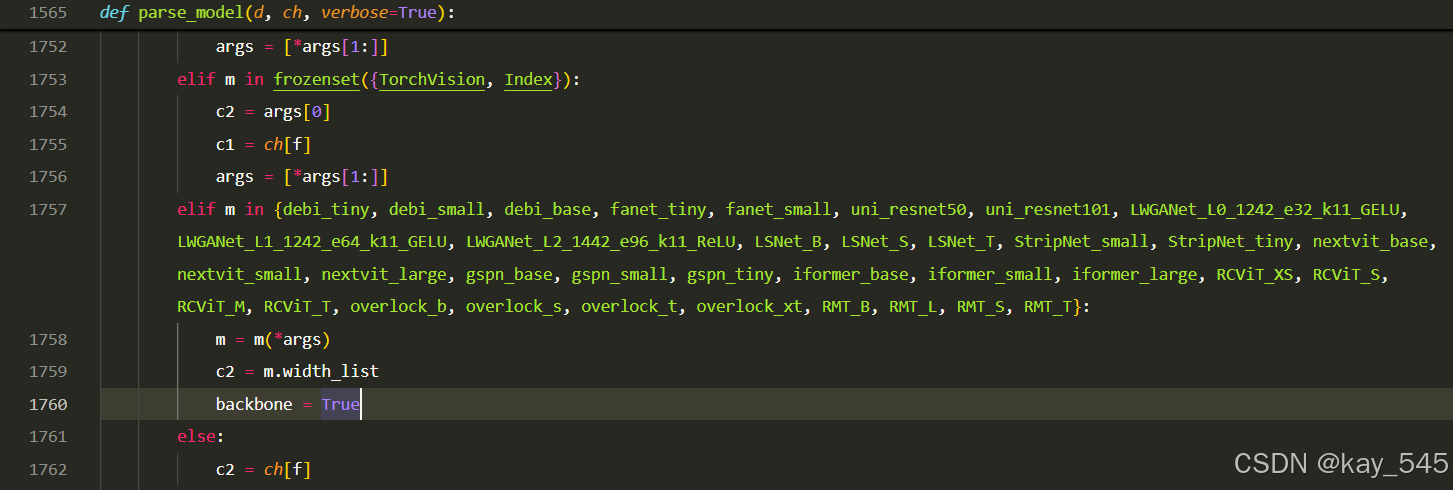
**关键步骤四:**在parse_model函数中进行注册,添加RMT
先在task.py导入函数

然后在task.py文件下找到parse_model这个函数,如下图,添加RMT
python
 elif m in {RMT_B, RMT_L, RMT_S, RMT_T}:
            m = m(*args)
            c2 = m.width_list
            backbone = True
        else:
            c2 = ch[f]
2.5 执行程序
关键步骤五: 在ultralytics文件中新建train.py,将model的参数路径设置为yolo26_RMT .yaml的路径即可 【注意是在外边的Ultralytics下新建train.py】
python
from ultralytics import YOLO
import warnings
warnings.filterwarnings('ignore')
from pathlib import Path

if __name__ == '__main__':


    # 加载模型
    model = YOLO("ultralytics/cfg/26/yolo26.yaml")  # 你要选择的模型yaml文件地址
    # Use the model
    results = model.train(data=r"你的数据集的yaml文件地址",
                          epochs=100, batch=16, imgsz=640, workers=4, name=Path(model.cfg).stem)  # 训练模型
🚀运行程序,如果出现下面的内容则说明添加成功🚀
python
                   from  n    params  module                                       arguments
  0                  -1  1  12678176  RMT_T                                        []
  1                  -1  1    394240  ultralytics.nn.modules.block.SPPF            [512, 256, 5]
  2                  -1  1    249728  ultralytics.nn.modules.block.C2PSA           [256, 256, 1]
  3                  -1  1         0  torch.nn.modules.upsampling.Upsample         [None, 2, 'nearest']
  4             [-1, 3]  1         0  ultralytics.nn.modules.conv.Concat           [1]
  5                  -1  1    127680  ultralytics.nn.modules.block.C3k2            [512, 128, 1, False]
  6                  -1  1         0  torch.nn.modules.upsampling.Upsample         [None, 2, 'nearest']
  7             [-1, 2]  1         0  ultralytics.nn.modules.conv.Concat           [1]
  8                  -1  1     32096  ultralytics.nn.modules.block.C3k2            [256, 64, 1, False]
  9                  -1  1     36992  ultralytics.nn.modules.conv.Conv             [64, 64, 3, 2]
 10             [-1, 9]  1         0  ultralytics.nn.modules.conv.Concat           [1]
 11                  -1  1     86720  ultralytics.nn.modules.block.C3k2            [192, 128, 1, False]
 12                  -1  1    147712  ultralytics.nn.modules.conv.Conv             [128, 128, 3, 2]
 13             [-1, 6]  1         0  ultralytics.nn.modules.conv.Concat           [1]
 14                  -1  1    378880  ultralytics.nn.modules.block.C3k2            [384, 256, 1, True]
 15        [12, 15, 18]  1    309656  ultralytics.nn.modules.head.Detect           [80, 1, True, [64, 128, 256]]
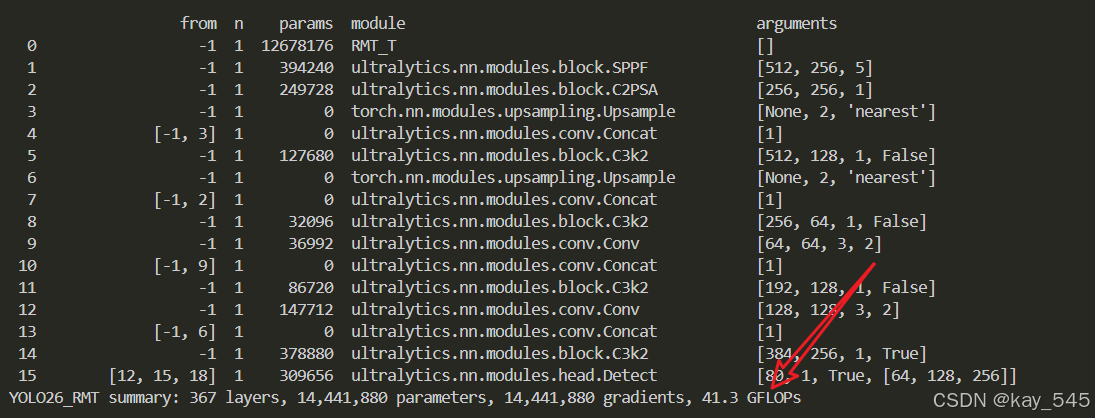
YOLO26_RMT summary: 367 layers, 14,441,880 parameters, 14,441,880 gradients, 41.3 GFLOPs
3. 完整代码分享
++主页侧边++
4. GFLOPs
关于GFLOPs的计算方式可以查看 :百面算法工程师 | 卷积基础知识------Convolution
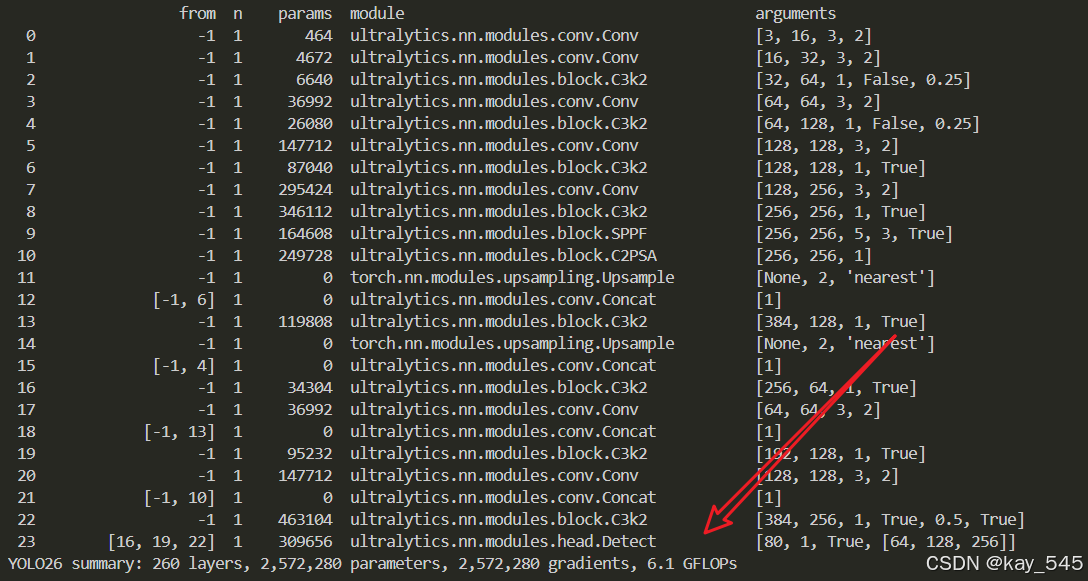
未改进的YOLO26n GFLOPs
改进后的GFLOPs
5. 进阶
可以与其他的注意力机制或者损失函数等结合,进一步提升检测效果
6.总结
通过以上的改进方法,我们成功提升了模型的表现。这只是一个开始,未来还有更多优化和技术深挖的空间。在这里,我想隆重向大家推荐我的专栏------<专栏地址: YOLO26改进-论文涨点------点击跳转看所有内容,关注不迷路!>。这个专栏专注于前沿的深度学习技术,特别是目标检测领域的最新进展,不仅包含对YOLO26的深入解析和改进策略,还会定期更新来自各大顶会(如CVPR、NeurIPS等)的论文复现和实战分享。
为什么订阅我的专栏? ------专栏地址:YOLO26改进-论文涨点------点击跳转看所有内容,关注不迷路!****
-
前沿技术解读:专栏不仅限于YOLO系列的改进,还会涵盖各类主流与新兴网络的最新研究成果,帮助你紧跟技术潮流。
-
详尽的实践分享 :所有内容实践性也极强。每次更新都会附带代码和具体的改进步骤,保证每位读者都能迅速上手。
-
问题互动与答疑 :订阅我的专栏后,你将可以随时向我提问,获取及时的答疑。
-
实时更新,紧跟行业动态:不定期发布来自全球顶会的最新研究方向和复现实验报告,让你时刻走在技术前沿。
专栏适合人群:
-
对目标检测、YOLO系列网络有深厚兴趣的同学
-
希望在用YOLO算法写论文的同学
-
对YOLO算法感兴趣的同学等