前言
本节参考资料:
TODO LIST
(已完成)Qwen3.5架构介绍
(正在完成)GemmaRMSNorm和MRoPE
(待完成)GDN线性注意力层
(待完成)多模态支持(视觉塔/多模态预处理/多模态条件生成类/权重加载)
(待完成)引擎(LLMEngine/Sequence/Scheduler/ModelRunner)修改
(待完成)MTP支持
(待完成)流式输出与多请求支持
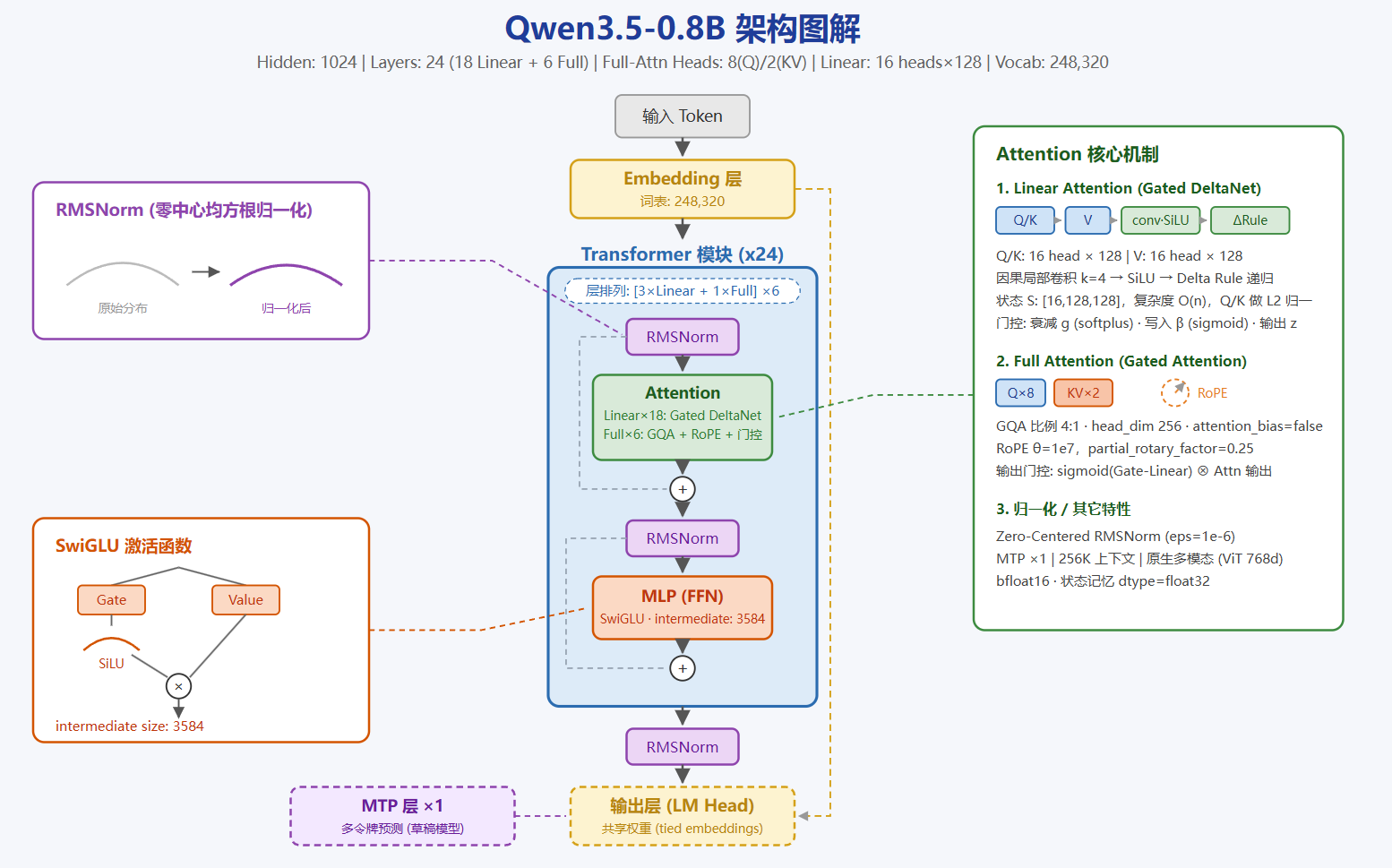
Qwen3.5架构图
本节修改的代码
layernorm.py
更改说明:增加了GemmaRMSNorm类和RMSNormGated类,前者是Qwen3.5-0.8B使用的对修改后的RMSNorm,主要是把(y=x/RMS(x)×γ变为了(y=x/RMS(x)×(γ+1))),简单修改即可。而后者是Qwen3.5-0.8B的Gated DeltaNet所需的模块,跟正常的RMSNorm区别不大,会在介绍这个网络的时候用到,他这里的silu区别于activation.py中的silu,因为这里的gate和hidden_state不是像之前可以一起得到的
python
class GemmaRMSNorm(nn.Module):
    """RMS normalization for Gemma.

    difference from the above RMSNorm:
        1. x * (1 + w) instead of x * w.
    """

    def __init__(
        self,
        hidden_size: int,
        eps: float = 1e-6,
    ) -> None:
        super().__init__()
        self.weight = nn.Parameter(torch.zeros(hidden_size))
        self.eps = eps

    @torch.compile
    def rms_forward(
        self,
        x: torch.Tensor,
        weight: torch.Tensor,
    ) -> torch.Tensor:
        orig_dtype = x.dtype
        x = x.float()
        var = x.pow(2).mean(dim=-1, keepdim=True)
        x.mul_(torch.rsqrt(var + self.eps))
        x = x.to(weight.dtype).mul_(weight)
        return x.to(orig_dtype)

    @torch.compile
    def add_rms_forward(
        self,
        x: torch.Tensor,
        residual: torch.Tensor,
        weight: torch.Tensor,
    ) -> tuple[torch.Tensor, torch.Tensor]:
        orig_dtype = x.dtype
        x = x.float().add_(residual.float())
        residual = x.to(orig_dtype)
        var = x.pow(2).mean(dim=-1, keepdim=True)
        x.mul_(torch.rsqrt(var + self.eps))
        x = x.to(weight.dtype).mul_(weight)
        return x.to(orig_dtype), residual

    def forward(
        self,
        x: torch.Tensor,
        residual: torch.Tensor | None = None,
    ) -> torch.Tensor | tuple[torch.Tensor, torch.Tensor]:
        """PyTorch-native implementation equivalent to forward()."""
        weight = self.weight.float() + 1.0
        if residual is None:
            return self.rms_forward(x, weight)
        return self.add_rms_forward(x, residual, weight)

class RMSNormGated(nn.Module):
    def __init__(
            self,
            hidden_size: int,
            eps: float = 1e-6,
            **kwargs
        ) -> None:
        super().__init__()
        self.weight = nn.Parameter(torch.ones(hidden_size))
        self.variance_epsilon = eps
        self.activation = "silu"

    def forward(
            self,
            hidden_states: torch.Tensor,
            gate: torch.Tensor
        ) -> torch.Tensor:
        input_dtype = hidden_states.dtype
        hidden_states = hidden_states.to(torch.float32)
        variance = hidden_states.pow(2).mean(-1, keepdim=True)
        # Norm before gate
        hidden_states = hidden_states * torch.rsqrt(variance + self.variance_epsilon)
        hidden_states = self.weight * hidden_states.to(input_dtype)
        hidden_states = hidden_states * nn.functional.silu(gate.to(torch.float32))

        return hidden_states.to(input_dtype)
rotary_embedding.py
更改说明:Qwen3.5系列采用了部分旋转位置编码(partial RoPE)和MRoPE的策略,因此我们需要修改原来的代码,主要是改动了apply_rotary_emb函数和RotaryEmbedding类以适配部分旋转位置编码,新增了MRotaryEmbedding类以支持MRoPE。这里没有对MRoPE进行缓存,主要是考虑到多维的旋转位置编码会导致位置编码的变化。
MRoPE介绍:【面试高频】M-RoPE 多模态位置编码全解
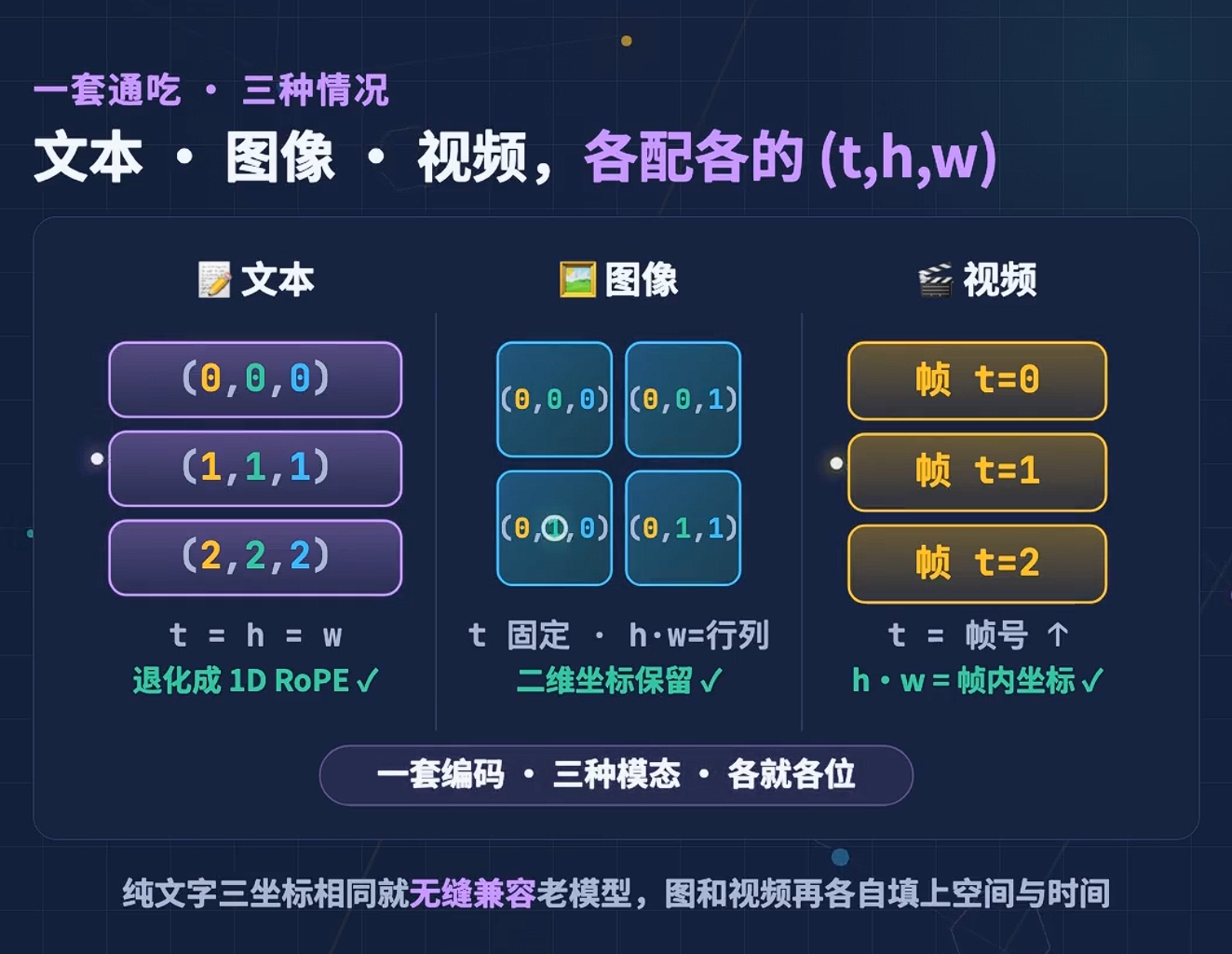
简单而言,就是对token的最后一维hidden_state,之前每一个地方的向量旋转角度只有位置决定,我们现在要把它拆成3块,每一块的向量旋转角度由对应的3个维度和维度中的位置决定(T时间\H高度\W宽度)
python
from functools import lru_cache
import torch
from torch import nn


# def apply_rotary_emb(
#     x: torch.Tensor,
#     cos: torch.Tensor,
#     sin: torch.Tensor,
# ) -> torch.Tensor:
#     x1, x2 = torch.chunk(x.float(), 2, dim=-1)
#     y1 = x1 * cos - x2 * sin
#     y2 = x2 * cos + x1 * sin
#     return torch.cat((y1, y2), dim=-1).to(x.dtype)

#新版本部分位置旋转兼容旧版本全位置旋转
def apply_rotary_emb(
        x: torch.Tensor,
        cos: torch.Tensor,
        sin: torch.Tensor
    ) -> torch.Tensor:
    rotary_dim = cos.size(-1) * 2          # 现有 cache/现算路径都给 32 → 64
    x_rot, x_pass = x[..., :rotary_dim], x[..., rotary_dim:]
    x1, x2 = torch.chunk(x_rot.float(), 2, dim=-1)
    y1 = x1 * cos - x2 * sin
    y2 = x2 * cos + x1 * sin
    return torch.cat((y1, y2, x_pass), dim=-1).to(x.dtype)


class RotaryEmbedding(nn.Module):

    def __init__(
        self,
        head_size: int,
        rotary_dim: int,
        max_position_embeddings: int,
        base: float,
    ) -> None:
        super().__init__()
        self.head_size = head_size
        # assert rotary_dim == head_size
        assert rotary_dim <= head_size and rotary_dim % 2 == 0
        inv_freq = 1.0 / (base**(torch.arange(0, rotary_dim, 2, dtype=torch.float) / rotary_dim))
        t = torch.arange(max_position_embeddings, dtype=torch.float)
        freqs = torch.einsum("i,j -> ij", t, inv_freq) # 外积:[位置数, 频率数]
        cos = freqs.cos()
        sin = freqs.sin()
        cache = torch.cat((cos, sin), dim=-1).unsqueeze_(1)
        self.register_buffer("cos_sin_cache", cache, persistent=False)

    @torch.compile
    def forward(
        self,
        positions: torch.Tensor,
        query: torch.Tensor,
        key: torch.Tensor,
    ) -> tuple[torch.Tensor, torch.Tensor]:
        cos_sin = self.cos_sin_cache[positions]
        cos, sin = cos_sin.chunk(2, dim=-1)
        query = apply_rotary_emb(query, cos, sin)
        key = apply_rotary_emb(key, cos, sin)
        return query, key

class MRotaryEmbedding(nn.Module):
    def __init__(
            self,
            head_size: int,
            rotary_dim: int,
            base: float,
            mrope_section=(11, 11, 10)
    ) -> None:
        super().__init__()
        self.head_size = head_size
        self.rotary_dim = rotary_dim
        inv_freq = 1.0 / (base ** (torch.arange(0, rotary_dim, 2, dtype=torch.float) / rotary_dim))
        self.register_buffer("inv_freq", inv_freq, persistent=False)
        # 预计算每个频率列取自 T/H/W 哪一路:默认 0(T),H 占 slice(1, s1*3, 3),W 占 slice(2, s2*3, 3)
        sel = torch.zeros(rotary_dim // 2, dtype=torch.long)
        sel[1 : mrope_section[1] * 3 : 3] = 1
        sel[2 : mrope_section[2] * 3 : 3] = 2
        self.register_buffer("freq_axis_sel", sel, persistent=False)

    def forward(
            self,
            positions: torch.Tensor,
            query: torch.Tensor,
            key: torch.Tensor
    ) -> tuple[torch.Tensor, torch.Tensor]:
        # positions: (3, N)       freqs: (3, N, 32)
        freqs = positions.float().unsqueeze(-1) * self.inv_freq
        #freqs.transpose(0, 1): (N, 3, 32)
        #index:sel (32,) → view → (1, 1, 32) → expand → (N, 1, 32)
        #freqs_t: (N, 32)
        freqs_t = freqs.transpose(0, 1).gather(1, self.freq_axis_sel.view(1, 1, -1).expand(freqs.size(1), 1, -1)).squeeze(1)
        #cos: (N, 1, 32)
        cos = freqs_t.cos().unsqueeze_(1)
        sin = freqs_t.sin().unsqueeze_(1)
        return apply_rotary_emb(query, cos, sin), apply_rotary_emb(key, cos, sin)
几个问题
python
1.self.register_buffer("freq_axis_sel", sel, persistent=False),这里最后的参数是什么意思

❌ 保存模型时不会保存这个 buffer

❌ 加载模型时不会恢复这个 buffer

❌ model.state_dict() 不包含这个 buffer

✅ model.to(device) 仍然会移动这个 buffer(因为存在内存中)
但如果设为True,前三个则反过来,最后一个不变

2.为什么foward前不能加@torch.compile

因为@torch.compile对gather不友好


3.为什么不将MRoPE进行缓存

这里主要是考虑到输入的不同,比如我输入文本、输入文本和图片、输入文本和视频都会导致位置编码变化。

而且图片的输入长宽会变,MRoPE就算考虑设置最大长宽,也会导致要保存的cos_sin太大

所以缓存不一定会命中,所以暂时不考虑,等后续优化时再看,这里可能把缓存队列开大一些可以支持特定情况下的缓存

4.mrope_section为什么是(11,11,10)

这里是考虑到rotary_dim是32维,而MRoPE简单来说就是让32维向量拆分成3个维度,每个维度单独使用ROPE
因此这里(11,11,10)是人为设计

5.解释freqs = positions.float().unsqueeze(-1) * self.inv_freq
     freqs_t = freqs.gather(0, self.freq_axis_sel.unsqueeze(0).expand(freqs[0].shape))

MRoPE的三个维度是(时间,高度,宽度),token也被要求给出自己这三个维度对应的数值

因此freqs -> freqs_t可以理解为,根据一个 token的每一个 hidden_state 中的每一个位置的值选 T/H/C 中的一个频率

gather介绍
# 如果 dim=0
out[i][j][k] = input[ index[i][j][k] ][ j ][ k ]
# 如果 dim=1
out[i][j][k] = input[ i ][ index[i][j][k] ][ k ]
# 如果 dim=2
out[i][j][k] = input[ i ][ j ][ index[i][j][k] ]
这个公式看起来可能有点抽象,它的具体工作过程是这样的:
确定输出位置:输出张量 out 的形状和 index 一模一样。我们会遍历 out 中的每一个位置(比如 (i, j, k))。
读取索引值:看 index 在同样位置 (i, j, k) 上的数值是多少。
替换对应维度的索引:
如果 dim=0,意味着我们要替换的是第一个维度的索引。所以,输出位置 (i, j, k) 的值,来自于 input 中位置 ( index[i][j][k], j, k ) 的元素。
如果 dim=1,就替换第二个维度的索引,取值位置变为 ( i, index[i][j][k], k )。以此类推。

gather的算法等价于
# freqs_t: [N,32] 输出
freqs_t = torch.empty(N, 32)
for n in range(N):          # 遍历每个token
    for i in range(32):     # 遍历每个频率(对应一对hidden)
        axis = freq_axis_sel[i]   # 0=T,1=H,2=W,只看i,不看n
        freqs_t[n,i] = positions[axis, n] * inv_freq[i]

因此如果是单模态,比如说纯文本,让T=H=C,这样就退化成了ROPE

6.我的疑惑是对于 hidden_state,他选了通道 [0,1,2,0,1,2...,0,1,2],apply 里面是 chunk 拆成了两份,那就成了 [0,1,2,0,1,2,0,1,2,0,1,2,0,1,2,0] 和 [1,2,0,1,2,0,1,2,0,1,2,0,1,2,0,1],然后再是旋转,问题是比如说第一个分量,分别是 0 和 1,这都不是一个通道,怎么能进行旋转?我的意思是 x_rot 里面存的是 [0,1,2,0,1,2] 对应的不同通道的频率,但我们 apply_rotary_embed 相当于对不同通道的频率进行计算

1.`i = 0,1,2,3,...31`:**频率索引**

- `freq_axis_sel[i] ∈ {0,1,2}`:决定**第 i 号频率**用 T/H/W 哪一套位置算出角度。
- 输出:`cos[...,i]`、`sin[...,i]`:这是**第 i 号频率的旋转角度系数**。

2. `x_rot`(hidden 向量,shape `[...,64]`)
物理排布硬规则(RoPE 原生约定,M‑RoPE 不改):

```
x_rot[..., 0], x_rot[..., 1]   ← 配对,使用 i=0 的cos/sin
x_rot[..., 2], x_rot[..., 3]   ← 配对,使用 i=1 的cos/sin
x_rot[..., 4], x_rot[..., 5]   ← 配对,使用 i=2 的cos/sin
x_rot[..., 6], x_rot[..., 7]   ← 配对,使用 i=3 的cos/sin
......
x_rot[...,2*i], x_rot[...,2*i+1] ← 配对,使用 i号频率的cos/sin
```

>
> 重点!
> hidden 上**位置 2i、2i+1 这一对,固定绑定第 i 号频率的 cos/sin**。
> 这个绑定关系是按数组下标位置硬绑定,**不会因为 sel [i]=0/1/2 发生任何改变**。
> `sel[i]` 仅仅改变:**i 号频率的 cos/sin 值是拿 T 算出来,还是 H、还是 W 算出来**。它绝不调换 hidden 配对关系。

举极简小例子,F=3(i=0,i=1,i=2)

- `freq_axis_sel = [0, 1, 2]`
  - i=0:选 T 位置算角度 → `cos0, sin0`
  - i=1:选 H 位置算角度 → `cos1, sin1`
  - i=2:选 W 位置算角度 → `cos2, sin2`

`x_rot = [a0,a1, b0,b1, c0,c1]`

- `a0,a1`:hidden 的 0、1 号位,**强制使用 i=0 的 (cos0,sin0)**(T 角度)
- `b0,b1`:hidden 的 2、3 号位,**强制使用 i=1 的 (cos1,sin1)**(H 角度)
- `c0,c1`:hidden 的 4、5 号位,**强制使用 i=2 的 (cos2,sin2)**(W 角度)
📚本系列文章(待写完修正)
2Nano-VLLM全代码解析笔记(2)-block_manager
3Nano-VLLM全代码解析笔记(3)-llm_engine和scheduler
4Nano-VLLM全代码解析笔记(4)-model_runner
5Nano-VLLM全代码解析笔记(5)-laynorm和attention
6Nano-VLLM全代码解析笔记(6)-embed_head和linear
7Nano-VLLM全代码解析笔记(7)-rotary_embedding
8Nano-VLLM全代码解析笔记(8)-qwen3与qwen3_moe