图(邻接表)-(DFS/BFS)-Dijkstra算法
基于一道简单实验,学习用邻接表结构储存图,并且包含DFS/BFS两种遍历方式,以及Dijkstra算法(朴素版)在本题的使用。
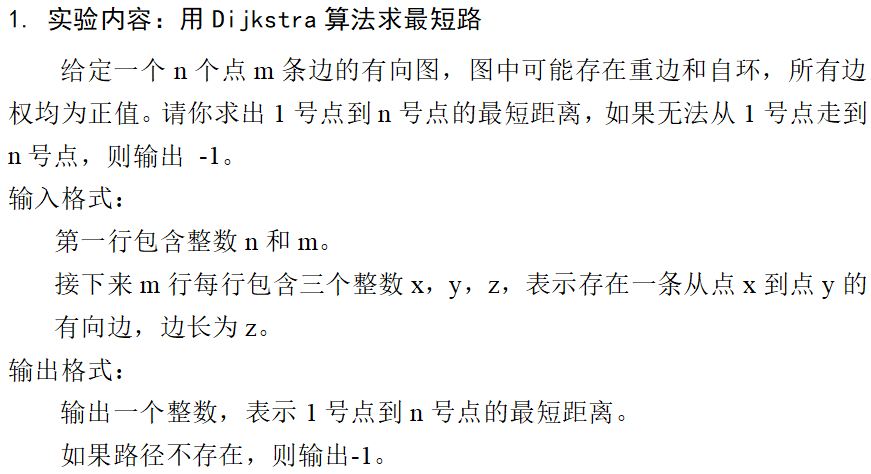
头文件(以及相关内容)
cpp
#include <cstdio>
#include <cstdlib>
#define MAX_VERTEX_NUM 20
#define INFINITY 0x3f3f3f3f
typedef char VertexType;
1.邻接表的构建
包含三个部分:
- 边节点
- 所指向边节点的索引(adjvex)
- 指向下一边节点的指针(nextarc)
- 顶点节点
- 储存该节点的信息(data)-----节点名称等
- 指向边节点的指针(firstarc)
- 组合成邻接表
- 顶点数组(vertices)
- 顶点数(vexnum)
- 边数(arcnum)
代码如下:
cpp
// 边节点结构
typedef struct ArcNode
{
    // 该边指向的点节点的索引
    int adjvex;
    // 权值
    int value;
    // 指向下一个边节点的指针
    struct ArcNode *nextarc;
} ArcNode;

// 顶点节点的结构
typedef struct VNode
{
    // 顶点节点的数据(顶点节点的名称)
    VertexType data;
    // 指向的第一个边节点
    ArcNode *firstarc;
} VNode, adjList[MAX_VERTEX_NUM];

// 邻接表表示的图的结构
typedef struct ALGraph
{
    // 顶点数组
    adjList vertices;
    // 顶点数,边数
    int vexnum, arcnum;
} ALGraph;
2.两种遍历
复用函数(vis --- 表示该顶点是否被访问;Visit函数 --- 访问该节点后的行为:打印节点信息)
cpp
int vis[MAX_VERTEX_NUM];
void Visit(const ALGraph &G,int v) {
    printf("%c ",G.vertices[v].data);
}
DFS遍历
cpp
void DFS(const ALGraph &G,int v) {
    vis[v]=1;
    Visit(G,v);
    ArcNode* p=G.vertices[v].firstarc;
    while(p!=NULL) {
        int w=p->adjvex;
        if(!vis[w]) {
            DFS(G,w);
        }
        p=p->nextarc;
    }
}
void DFSTraverse(const ALGraph &G) {
    int n=G.vexnum;
    for(int i=0; i<n; i++) {
        vis[i]=0;
    }
    for(int i=0; i<n; i++) {
        if(!vis[i]) {
            DFS(G,i);
        }
    }
}
BFS遍历
(懒的补充写队列中的入队、出队函数,也不用STL,采用双指针的移动来模拟入队、出队 )
注:front++相当于出队,rear++相当于入队
cpp
void BFS(const ALGraph &G,int v) {
    int Queue[MAX_VERTEX_NUM];
    int front=0,rear=0;

    vis[v]=1;
    Visit(G,v);
    Queue[rear++]=v;
    while(front<rear) {
        int u=Queue[front];
        front++;
        ArcNode* p=G.vertices[u].firstarc;
        while(p!=NULL) {
            int w=p->adjvex;
            if(!vis[w]) {
                vis[w]=1;
                Visit(G,w);
                Queue[rear++]=w;
            }
            p=p->nextarc;
        }
    }
}
void BFSTraverse(const ALGraph &G) {
    int n=G.vexnum;
    for(int i=0; i<n; i++) {
        vis[i]=0;
    }
    for(int i=0; i<n; i++) {
        if(!vis[i]) {
            BFS(G,i);
        }
    }
}
3.Dijkstra算法(朴素版)
主要核心:
- 初始化距离:设定源节点到自身的距离为 0,到其他所有节点的距离为 (INFINITY:0x3f3f3f3f)。
- 贪心选择:每次从未确定最短路径的节点中,选择当前距离源节点最近的节点 u,将其标记为 "已确定最短路径"。(distu)
- 松弛操作 :对节点 u 的所有邻接节点 v,尝试通过 u 更新 v 的最短距离。
松弛条件:若 distv > distu + w(u, v),则更新 distv = distu + w(u, v)。 - 重复步骤 2-3:直到所有节点都被标记为 "已确定最短路径"。
Dijkstra 算法贪心选择正确性证明:
- 前提
- 图中所有边权非负;
- S:已确定最短路径的节点集合;
- dist u:当前已知 s 到 u 的最短距离上界。
- 反证法证明
假设:选 u 时,存在更短的 s→u 路径 P,长度<dist u。拆分路径 P:s→...→x(x∈S,P 上最后一个在 S 中的节点)→y(y∉S,P 上第一个不在 S 中的节点)→...→u。
因 x∈S,其最短路径已确定(dist x = 真实最短距离);又边权非负,所以 s→y 的真实最短距离 ≤ s→x→y 的长度 ≤ 路径 P 的长度(y 到 u 的路径权值≥0,不会缩短)。
结合假设 "P 长度<dist u",可推出:s→y 的真实最短距离 < dist u。但 dist y 是 s→y 的距离上界(dist y≥真实最短距离),因此 dist y < dist u。
这与「u 是当前未确定节点中 dist 最小的节点」矛盾,故假设不成立。 - 结论
每次选的 u,其当前 dist u 就是 s 到 u 的最短路径,后续不会被更新。
(代码如下:)
cpp
//通过Dijkstra算法求最短路径
int Dijkstra(const ALGraph &G,int start) {
    int n=G.vexnum;
    int* dist=(int*)malloc(n*sizeof(int)); //dist[i]与起点的距离
    int* visited=(int*)malloc(n*sizeof(int));//visited[i]==1时,最短路径确定

    //初始化
    for(int i=0; i<n; i++) {
        dist[i]=INFINITY;
        visited[i]=0;
    }
    dist[start]=0;

    for(int i=0; i<n; i++) {
        int u=-1;
        int min_dist=INFINITY;
        //(贪心选择)
        //从未确定的顶点中,找距离起点最近的顶点,找到后该顶点距离起点的最短距离即可确定
        for(int j=0; j<n; j++) {
            if(!visited[j]&&dist[j]<min_dist) {
                min_dist=dist[j];
                u=j;
            }
        }
        if(u==-1) break;
        visited[u]=1;
        if(u==n-1) break;
        //松弛操作
        ArcNode* p=G.vertices[u].firstarc;
        while(p!=NULL) {
            int v=p->adjvex;
            int w=p->value;
            if(!visited[v] && dist[u]!=INFINITY && dist[u]+w<dist[v]) {
                dist[v]=dist[u]+w;
            }
            p=p->nextarc;
        }
    }
    int result=dist[n-1];
    free(dist);
    free(visited);
    return result;
}
4.综上所述(完整代码如下)
cpp
#include<cstdio>
#include<cstdlib>
#define MAX_VERTEX_NUM 20
#define INFINITY 0x3f3f3f3f
typedef char VertexType;

//边节点结构
typedef struct ArcNode {
    //该边指向的点节点的索引
    int adjvex;
    //权值
    int value;
    //指向下一个边节点的指针
    struct ArcNode* nextarc;
} ArcNode;

//顶点节点的结构
typedef struct VNode {
    //顶点节点的数据(顶点节点的名称)
    VertexType data;
    //指向的第一个边节点
    ArcNode* firstarc;
} VNode,adjList[MAX_VERTEX_NUM];

//邻接表表示的图的结构
typedef struct ALGraph {
    //顶点数组
    adjList vertices;
    //顶点数,边数
    int vexnum,arcnum;
} ALGraph;

//返回节点在数组中的索引
int LocateVex(const ALGraph &G,VertexType V) {
    for(int i=0; i<G.vexnum; i++) {
        if(G.vertices[i].data==V)
            return i;
    }
    return -1;
}

//图的创建
int CreateDG(ALGraph &G) {
    //输入顶点数和边数
    printf("请输入顶点数与边数:\n");
    scanf("%d %d",&G.vexnum,&G.arcnum);
    getchar();

    //输入顶点信息(顶点的名称等)
    printf("请输入%d个顶点的信息:\n",G.vexnum);
    for(int i=0; i<G.vexnum; i++) {
        scanf("%c",&G.vertices[i].data);
        getchar();
        //初始化
        G.vertices[i].firstarc=NULL;
    }

    //输入边的信息
    VertexType V1,V2;
    int v;
    ArcNode* p;
    printf("请输入%d条边的信息:\n",G.arcnum);
    for(int k=0; k<G.arcnum; k++) {
        scanf("%c %c %d",&V1,&V2,&v);
        getchar();
        int i=LocateVex(G,V1);
        int j=LocateVex(G,V2);
        if(i==-1||j==-1)
            return 0;

        p=(ArcNode*)malloc(sizeof(ArcNode));
        p->adjvex=j;
        p->value=v;
        //头插法
        p->nextarc=G.vertices[i].firstarc;
        G.vertices[i].firstarc=p;
    }
    return 1;
}

//遍历
int vis[MAX_VERTEX_NUM];
void Visit(const ALGraph &G,int v) {
    printf("%c ",G.vertices[v].data);
}
//DFS
void DFS(const ALGraph &G,int v) {
    vis[v]=1;
    Visit(G,v);
    ArcNode* p=G.vertices[v].firstarc;
    while(p!=NULL) {
        int w=p->adjvex;
        if(!vis[w]) {
            DFS(G,w);
        }
        p=p->nextarc;
    }
}
void DFSTraverse(const ALGraph &G) {
    int n=G.vexnum;
    for(int i=0; i<n; i++) {
        vis[i]=0;
    }
    for(int i=0; i<n; i++) {
        if(!vis[i]) {
            DFS(G,i);
        }
    }
}

//BFS
void BFS(const ALGraph &G,int v) {
    int Queue[MAX_VERTEX_NUM];
    int front=0,rear=0;

    vis[v]=1;
    Visit(G,v);
    Queue[rear++]=v;
    while(front<rear) {
        int u=Queue[front];
        front++;
        ArcNode* p=G.vertices[u].firstarc;
        while(p!=NULL) {
            int w=p->adjvex;
            if(!vis[w]) {
                vis[w]=1;
                Visit(G,w);
                Queue[rear++]=w;
            }
            p=p->nextarc;
        }
    }
}
void BFSTraverse(const ALGraph &G) {
    int n=G.vexnum;
    for(int i=0; i<n; i++) {
        vis[i]=0;
    }
    for(int i=0; i<n; i++) {
        if(!vis[i]) {
            BFS(G,i);
        }
    }
}

//通过Dijkstra算法求最短路径
int Dijkstra(const ALGraph &G,int start) {
    int n=G.vexnum;
    int* dist=(int*)malloc(n*sizeof(int)); //dist[i]与起点的距离
    int* visited=(int*)malloc(n*sizeof(int));//visited[i]==1时,最短路径确定

    //初始化
    for(int i=0; i<n; i++) {
        dist[i]=INFINITY;
        visited[i]=0;
    }
    dist[start]=0;

    for(int i=0; i<n; i++) {
        int u=-1;
        int min_dist=INFINITY;
        //(贪心选择)
        //从未确定的顶点中,找距离起点最近的顶点,找到后该顶点距离起点的最短距离即可确定
        for(int j=0; j<n; j++) {
            if(!visited[j]&&dist[j]<min_dist) {
                min_dist=dist[j];
                u=j;
            }
        }
        if(u==-1) break;
        visited[u]=1;
        if(u==n-1) break;
        //松弛操作
        ArcNode* p=G.vertices[u].firstarc;
        while(p!=NULL) {
            int v=p->adjvex;
            int w=p->value;
            if(!visited[v] && dist[u]!=INFINITY && dist[u]+w<dist[v]) {
                dist[v]=dist[u]+w;
            }
            p=p->nextarc;
        }
    }
    int result=dist[n-1];
    free(dist);
    free(visited);
    return result;
}

//主程序
int main() {
    ALGraph G;
    if(CreateDG(G)) {
        printf("成功\n");
    }
    else printf("失败\n");
    //DFS遍历
    printf("DFS遍历结果:");
    DFSTraverse(G);
    printf("\n");

    //BFS遍历
    printf("BFS遍历结果:");
    BFSTraverse(G);
    printf("\n");

    int min=Dijkstra(G,0);
    printf("%d",min);
    return 0;
}
5.补充(用DFS/BFS解决该题)
DFS
cpp
#include<cstdio>
#include<cstdlib>
#define MAX_VERTEX_NUM 20
#define INFINITY 0x3f3f3f3f

typedef char VertexType;
//边节点
typedef struct ArcNode{
    int adjvex;
    int value;
    struct ArcNode* nextarc;
}ArcNode;

//顶点节点
typedef struct VNode{
    VertexType data;
    ArcNode* firstarc;
}VNode,adjList[MAX_VERTEX_NUM];

//构建邻接表
typedef struct ALgraph{
    adjList vertices;
    int vexnum,arcnum;
}ALgraph;

//返回节点的索引
int LocateVex(const ALgraph &G,VertexType e){
    for(int i=0;i<G.vexnum;i++){
        if(G.vertices[i].data==e){
            return i;
        }
    }
    return -1;
}

//创建图
int CreateDG(ALgraph &G){
    printf("请输入顶点数和边数:\n");
    scanf("%d %d",&G.vexnum,&G.arcnum);
    getchar();

    printf("请输入顶点的信息:\n");
    for(int i=0;i<G.vexnum;i++){
        scanf("%c",&G.vertices[i].data);
        getchar();
        G.vertices[i].firstarc=NULL;
    }

    printf("请输入边的关系:\n");
    ArcNode* p;
    VertexType V1,V2;
    int v;
    for(int k=0;k<G.arcnum;k++){
        scanf("%c %c %d",&V1,&V2,&v);
        getchar();

        int i=LocateVex(G,V1);
        int j=LocateVex(G,V2);
        if(i==-1||j==-1){
            return 0;
        }

        p=(ArcNode*)malloc(sizeof(ArcNode));
        p->adjvex=j;
        p->value=v;
        p->nextarc=G.vertices[i].firstarc;
        G.vertices[i].firstarc=p;
    }
    return 1;
}

//用DFS求第一个顶点到最后一个顶点的最短路径
int min_dist = INFINITY;
int cur_dist = 0;
int visited[MAX_VERTEX_NUM];
void DFS(const ALgraph &G, int idx) {
    int n = G.vexnum;
    if (idx == n - 1) {
        if (cur_dist < min_dist) min_dist = cur_dist;
        return;
    }

    visited[idx] = 1;
    ArcNode* p = G.vertices[idx].firstarc;
    while (p != NULL) {
        int next_idx = p->adjvex;
        int weight = p->value;
        if (!visited[next_idx]) {
            cur_dist += weight;
            DFS(G, next_idx);
            cur_dist -= weight;
        }
        p = p->nextarc;
    }
    visited[idx] = 0;
}

int main(){
    ALgraph G;
    if(CreateDG(G)){
        printf("创建成功\n");
    }
    else printf("创建失败\n");
    for(int i=0;i<G.vexnum;i++){
        visited[i]=0;
    }
    DFS(G,0);
    printf("%d",min_dist);
    return 0;
}
BFS
cpp
#include<cstdio>
#include<cstdlib>
#define MAX_VERTEX_NUM 20
#define INFINITY 0x3f3f3f3f

typedef char VertexType;
//边节点
typedef struct ArcNode{
    int adjvex;
    int value;
    struct ArcNode* nextarc;
}ArcNode;

//顶点节点
typedef struct VNode{
    VertexType data;
    ArcNode* firstarc;
}VNode,adjList[MAX_VERTEX_NUM];

//构建邻接表
typedef struct ALgraph{
    adjList vertices;
    int vexnum,arcnum;
}ALgraph;

//返回节点的索引
int LocateVex(const ALgraph &G,VertexType e){
    for(int i=0;i<G.vexnum;i++){
        if(G.vertices[i].data==e){
            return i;
        }
    }
    return -1;
}

//创建图
int CreateDG(ALgraph &G){
    printf("请输入顶点数和边数:\n");
    scanf("%d %d",&G.vexnum,&G.arcnum);
    getchar();

    printf("请输入顶点的信息:\n");
    for(int i=0;i<G.vexnum;i++){
        scanf("%c",&G.vertices[i].data);
        getchar();
        G.vertices[i].firstarc=NULL;
    }

    printf("请输入边的关系:\n");
    ArcNode* p;
    VertexType V1,V2;
    int v;
    for(int k=0;k<G.arcnum;k++){
        scanf("%c %c %d",&V1,&V2,&v);
        getchar();

        int i=LocateVex(G,V1);
        int j=LocateVex(G,V2);
        if(i==-1||j==-1){
            return 0;
        }

        p=(ArcNode*)malloc(sizeof(ArcNode));
        p->adjvex=j;
        p->value=v;
        p->nextarc=G.vertices[i].firstarc;
        G.vertices[i].firstarc=p;
    }
    return 1;
}

//用BFS求第一个顶点到最后一个顶点的最短路径
typedef struct QNode{
    int idx;
    int path_len;//起点到路径的长度
}QNode;

int BFS(const ALgraph &G){
    int n=G.vexnum;
    int* dist=(int*)malloc(n*sizeof(int));
    for(int i=0;i<n;i++){
        dist[i]=INFINITY;
    }

    QNode queue[MAX_VERTEX_NUM*10];
    int front=0,rear=0;
    queue[rear].idx=0;
    queue[rear].path_len=0;
    rear++;
    while(front<rear){
        QNode cur=queue[front];
        front++;
        int cur_idx=cur.idx;
        int cur_len=cur.path_len;
        if(cur_len>dist[cur_idx]){
            continue;
        }
        ArcNode* p=G.vertices[cur_idx].firstarc;
        while(p!=NULL){
            int next_idx=p->adjvex;
            int weight=p->value;
            int new_len=cur_len+weight;
            if(new_len<dist[next_idx]){
                dist[next_idx]=new_len;
                queue[rear].idx=next_idx;
                queue[rear].path_len=new_len;
                rear++;
            }
            p=p->nextarc;
        }
    }
    int result=dist[n-1];
    free(dist);
    return result;
}

int main(){
    ALgraph G;
    if(CreateDG(G)){
        printf("创建成功\n");
    }
    else printf("创建失败\n");
    int result=BFS(G);
    printf("%d",result);
    return 0;
}