【LetMeFly】3047.求交集区域内的最大正方形面积:2层循环暴力枚举
力扣题目链接:https://leetcode.cn/problems/find-the-largest-area-of-square-inside-two-rectangles/
在二维平面上存在 n 个矩形。给你两个下标从 0 开始的二维整数数组 bottomLeft 和 topRight,两个数组的大小都是 n x 2 ,其中 bottomLeft[i] 和 topRight[i] 分别代表第 i 个矩形的左下角 和 右上角坐标。
我们定义 向右 的方向为 x 轴正半轴(x 坐标增加 ),向左 的方向为 x 轴负半轴(x 坐标减少 )。同样地,定义 向上 的方向为 y 轴正半轴(y 坐标增加 ),向下 的方向为 y 轴负半轴(y 坐标减少)。
你可以选择一个区域,该区域由两个矩形的 交集 形成。你需要找出能够放入该区域 内 的最大正方形面积,并选择最优解。
返回能够放入交集区域的正方形的 最大 可能面积,如果矩形之间不存在任何交集区域,则返回 0。
示例 1:
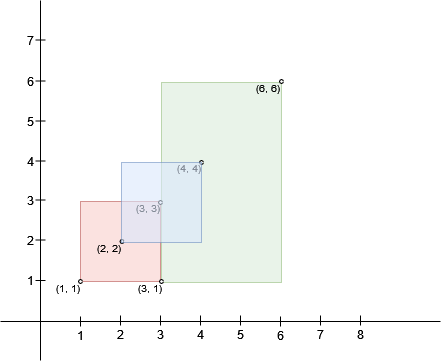
输入:bottomLeft = [[1,1],[2,2],[3,1]], topRight = [[3,3],[4,4],[6,6]]
输出:1
解释:边长为 1 的正方形可以放入矩形 0 和矩形 1 的交集区域,或矩形 1 和矩形 2 的交集区域。因此最大面积是边长 * 边长,即 1 * 1 = 1。
可以证明,边长更大的正方形无法放入任何交集区域。
示例 2:
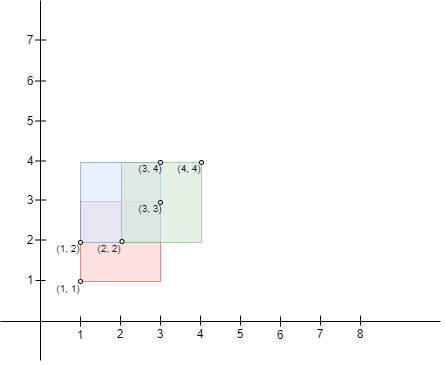
输入:bottomLeft = [[1,1],[2,2],[1,2]], topRight = [[3,3],[4,4],[3,4]]
输出:1
解释:边长为 1 的正方形可以放入矩形 0 和矩形 1,矩形 1 和矩形 2,或所有三个矩形的交集区域。因此最大面积是边长 * 边长,即 1 * 1 = 1。
可以证明,边长更大的正方形无法放入任何交集区域。
请注意,区域可以由多于两个矩形的交集构成。
示例 3:
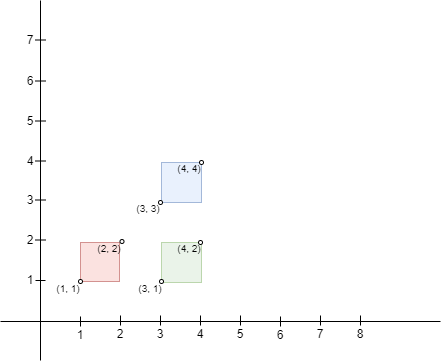
输入:bottomLeft = [[1,1],[3,3],[3,1]], topRight = [[2,2],[4,4],[4,2]]
输出:0
解释:不存在相交的矩形,因此,返回 0 。
提示:
n == bottomLeft.length == topRight.length2 <= n <= 103bottomLeft[i].length == topRight[i].length == 21 <= bottomLeft[i][0], bottomLeft[i][1] <= 1071 <= topRight[i][0], topRight[i][1] <= 107bottomLeft[i][0] < topRight[i][0]bottomLeft[i][1] < topRight[i][1]
解题方法:暴力模拟
一维坐标上,一个线段坐标从 a a a到 b b b,一个线段坐标从 c c c到 d d d,它们的相交部分有多长?
min ( b , d ) − max ( a , c ) \min(b, d) - \max(a, c) min(b,d)−max(a,c),再与 0 0 0取一个最大值就好了(右端点最小值减去左端点最大值)
依次判断两个正方形在横纵坐标轴上的相交长度,最小值的平方即为最大正方形的面积。
- 时间复杂度 O ( n 2 ) O(n^2) O(n2)
- 空间复杂度 O ( 1 ) O(1) O(1)
AC代码
C++
cpp
/*
 * @LastEditTime: 2026-01-17 20:02:05
 */
typedef long long ll;

class Solution {
private:
    // a->b VS c->d
    ll getDiff(int a, int b, int c, int d) {
        return max(0, min(b, d) - max(a, c));
    }
public:
    long long largestSquareArea(vector<vector<int>>& bottomLeft, vector<vector<int>>& topRight) {
        ll ans = 0;
        for (int i = 0; i < bottomLeft.size(); i++) {
            for (int j = i + 1; j < bottomLeft.size(); j++) {
                ll dx = getDiff(bottomLeft[i][0], topRight[i][0], bottomLeft[j][0], topRight[j][0]);
                ll dy = getDiff(bottomLeft[i][1], topRight[i][1], bottomLeft[j][1], topRight[j][1]);
                ans = max(ans, min(dx, dy) * min(dx, dy));
            }
        }
        return ans;
    }
};同步发文于CSDN和我的个人博客,原创不易,转载经作者同意后请附上原文链接哦~
千篇源码题解已开源