1984. Minimum Difference Between Highest and Lowest of K Scores1984. Minimum Difference Between Highest and Lowest of K Scores1984. Minimum Difference Between Highest and Lowest of K Scores
Easy
You are given a 0-indexed integer array nums, where nums[i] represents the score of the ith student. You are also given an integer k.
Pick the scores of any k students from the array so that the difference between the highest and the lowest of the k scores is minimized.
Return the minimum possible difference.
Example 1:
Input: nums = [90], k = 1
Output: 0
Explanation: There is one way to pick score(s) of one student:
- [90]. The difference between the highest and lowest score is 90 - 90 = 0.
The minimum possible difference is 0.
Example 2:
Input: nums = [9,4,1,7], k = 2
Output: 2
Explanation: There are six ways to pick score(s) of two students:
- [9,4,1,7]. The difference between the highest and lowest score is 9 - 4 = 5.
- [9,4,1,7]. The difference between the highest and lowest score is 9 - 1 = 8.
- [9,4,1,7]. The difference between the highest and lowest score is 9 - 7 = 2.
- [9,4,1,7]. The difference between the highest and lowest score is 4 - 1 = 3.
- [9,4,1,7]. The difference between the highest and lowest score is 7 - 4 = 3.
- [9,4,1,7]. The difference between the highest and lowest score is 7 - 1 = 6.
The minimum possible difference is 2.
Constraints:
1 <= k <= nums.length <= 10000 <= nums[i] <= 105
06年看看之前写的解题文章,居然一共有10w+浏览量了, 2026年了,跳槽还得刷题,不只是该作何感想,多想无益,这次用Python,AI时代,换主力语言
这个题,暴力解法就是遍历所有的组合可能,然后分别求最小的difference,太久不做算法提了,其他什么都想不出来。。。big O 也想不出来,直接看答案学习了
官方的hint已经很精辟了
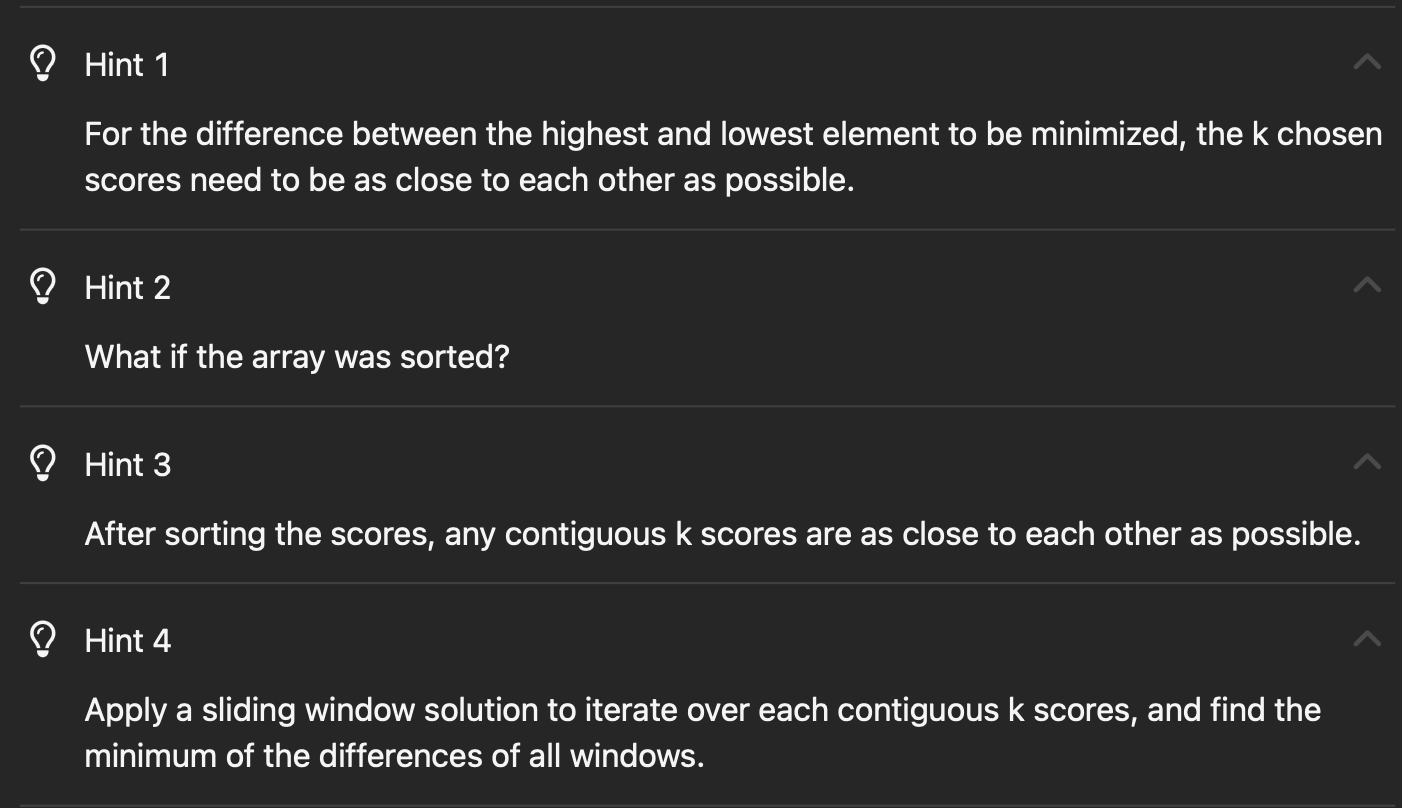
先排序,然后维护一个长度为k的sliding window,遍历一遍即可找到答案
python
class Solution:
    def minimumDifference(self, nums: List[int], k: int) -> int:
        sortedNums = sorted(nums)
        start = 0
        l = len(sortedNums)
        res = sortedNums[l - 1] - sortedNums[0]
        for start in range(0, l - k + 1):
            res = min(res, sortedNums[start + k - 1] - sortedNums[start])
        return res
我的代码如上,对Python还不是特别熟悉,不够简练,另外range,以及start end index的设置也费了点脑子,用一个例子比用脑子想容易很多
比如
python
0, 1, 2, 3 # index

1, 2, 3, 4 # size

k = 2

start from 0 to 2, range (0, 3)
2 = 4 - 2
when start = 2, end  = 3, end  = start + k - 1
让GPT评价了一下,优化如下
Your code is correct and idiomatic for the standard solution (sort + fixed-size window).
What's good
-
Correct logic: after sorting, the minimum difference among any size-k subset is the minimum of ai+k-1 - ai.
-
Complexity: O(n log n) time for sorting + O(n) scan; O(n) extra space because sorted() returns a new list.
-
Clean window indexing; no off-by-one issues.
Small improvements
-
start = 0 before the loop is unused (can remove).
-
Use clearer names + handle edge cases explicitly (optional).
A slightly cleaner version:
python
class Solution:
    def minimumDifference(self, nums: List[int], k: int) -> int:
        if k <= 1:
            return 0

        nums.sort()  # in-place, saves memory vs sorted(nums)
        res = float("inf")

        for i in range(len(nums) - k + 1):
            res = min(res, nums[i + k - 1] - nums[i])

        return res
Opinion: Prefer nums.sort() over sorted(nums) in LeetCode unless you need to preserve the original list.
确实更简洁