Aho-Corasick 模式搜索算法
给定一个输入文本和一个数组 k 个单词 arr\[\],找出输入文本中所有单词的所有出现。设n为文本长度,m为所有单词的字符总数,即m = 长度(arr0) + length(arr1) + ... + 长度(arrk-1)。这里 k 是输入词的总数。
示例:
Input: text = "ahishers"
       arr[] = {"he", "she", "hers", "his"}

Output:
   Word his appears from 1 to 3
   Word he appears from 4 to 5
   Word she appears from 3 to 5
   Word hers appears from 4 to 7
如果我们使用像KMP这样的线性时间搜索算法,那么我们需要逐个搜索文本中的所有单词。这给出了总时间复杂度为 O(n + 长度(字0) + O(n + 长度(字1) + O(n + 长度(字2) + ...O(n + 长度(wordk-1)。该时间复杂度可写为 O(n*k + m)。
Aho-Corasick算法在O(n + m + z)时间内找到所有单词,其中z为文本中单词出现次数的总数。Aho--Corasick字符串匹配算法构成了最初Unix命令fgrep的基础。
预处理: 构建一个由arr中所有单词组成的自动机\[\]该自动机主要具有三个功能:
Go To :   This function simply follows edges
          of Trie of all words in arr[]. It is
          represented as 2D array g[][] where
          we store next state for current state
          and character.

Failure : This function stores all edges that are
          followed when current character doesn't
          have edge in Trie.  It is represented as
          1D array f[] where we store next state for
          current state.

Output :  Stores indexes of all words that end at
          current state. It is represented as 1D
          array o[] where we store indexes
          of all matching words as a bitmap for
          current state.
匹配:在构建的自动机上遍历给定文本,找到所有匹配的单词。
预处理:
我们首先构建一个所有单词的Trie(或关键词树)。
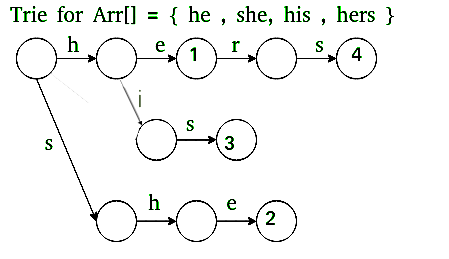
该部分填充 goto g\[\]\[\] 的条目,输出 o\[\]。
接下来我们将Trie扩展到自动机中,以支持线性时间匹配。
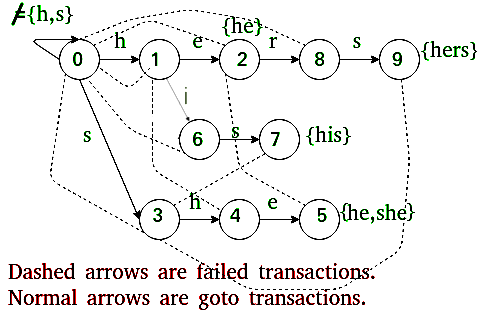
该部分填充失败 f\[\] 和输出 o\[\] 的条目。
前往:
我们构建Trie。对于所有没有根边的字符,我们会把边再加回根。
失败:
对于状态s,我们找到最长的真后缀,即某个模式的真前缀。这是通过广度首次遍历Trie实现的。
输出:
对于状态s,存储所有以s结尾的词的索引。这些索引以位映射形式存储(通过对数值进行逐位或对数值进行)。这同样是使用失效广度优先遍历计算。
以下是Aho-Corasick算法的实现
// Java program for implementation of
// Aho Corasick algorithm for String
// matching
import java.util.*;

class GFG{

// Max number of states in the matching
// machine. Should be equal to the sum
// of the length of all keywords.
static int MAXS = 500;

// Maximum number of characters
// in input alphabet
static int MAXC = 26;

// OUTPUT FUNCTION IS IMPLEMENTED USING out[]
// Bit i in this mask is one if the word with
// index i appears when the machine enters
// this state.
static int []out = new int[MAXS];

// FAILURE FUNCTION IS IMPLEMENTED USING f[]
static int []f = new int[MAXS];

// GOTO FUNCTION (OR TRIE) IS
// IMPLEMENTED USING g[][]
static int [][]g = new int[MAXS][MAXC];

// Builds the String matching machine.
// arr -   array of words. The index of each keyword is important:
//         "out[state] & (1 << i)" is > 0 if we just found word[i]
//         in the text.
// Returns the number of states that the built machine has.
// States are numbered 0 up to the return value - 1, inclusive.
static int buildMatchingMachine(String arr[], int k)
{

    // Initialize all values in output function as 0.
    Arrays.fill(out, 0);

    // Initialize all values in goto function as -1.
    for(int i = 0; i < MAXS; i++)
        Arrays.fill(g[i], -1);

    // Initially, we just have the 0 state
    int states = 1;

    // Convalues for goto function, i.e., fill g[][]
    // This is same as building a Trie for arr[]
    for(int i = 0; i < k; ++i)
    {
        String word = arr[i];
        int currentState = 0;

        // Insert all characters of current
        // word in arr[]
        for(int j = 0; j < word.length(); ++j)
        {
            int ch = word.charAt(j) - 'a';

            // Allocate a new node (create a new state)
            // if a node for ch doesn't exist.
            if (g[currentState][ch] == -1)
                g[currentState][ch] = states++;

            currentState = g[currentState][ch];
        }

        // Add current word in output function
        out[currentState] |= (1 << i);
    }

    // For all characters which don't have
    // an edge from root (or state 0) in Trie,
    // add a goto edge to state 0 itself
    for(int ch = 0; ch < MAXC; ++ch)
        if (g[0][ch] == -1)
            g[0][ch] = 0;

    // Now, let's build the failure function
    // Initialize values in fail function
    Arrays.fill(f, -1);

    // Failure function is computed in
    // breadth first order
    // using a queue
    Queue<Integer> q = new LinkedList<>();

    // Iterate over every possible input
    for(int ch = 0; ch < MAXC; ++ch)
    {

        // All nodes of depth 1 have failure
        // function value as 0. For example,
        // in above diagram we move to 0
        // from states 1 and 3.
        if (g[0][ch] != 0)
        {
            f[g[0][ch]] = 0;
            q.add(g[0][ch]);
        }
    }

    // Now queue has states 1 and 3
    while (!q.isEmpty())
    {

        // Remove the front state from queue
        int state = q.peek();
        q.remove();

        // For the removed state, find failure
        // function for all those characters
        // for which goto function is
        // not defined.
        for(int ch = 0; ch < MAXC; ++ch)
        {

            // If goto function is defined for
            // character 'ch' and 'state'
            if (g[state][ch] != -1)
            {

                // Find failure state of removed state
                int failure = f[state];

                // Find the deepest node labeled by proper
                // suffix of String from root to current
                // state.
                while (g[failure][ch] == -1)
                      failure = f[failure];

                failure = g[failure][ch];
                f[g[state][ch]] = failure;

                // Merge output values
                out[g[state][ch]] |= out[failure];

                // Insert the next level node
                // (of Trie) in Queue
                q.add(g[state][ch]);
            }
        }
    }
    return states;
}

// Returns the next state the machine will transition to using goto
// and failure functions.
// currentState - The current state of the machine. Must be between
//                0 and the number of states - 1, inclusive.
// nextInput - The next character that enters into the machine.
static int findNextState(int currentState, char nextInput)
{
    int answer = currentState;
    int ch = nextInput - 'a';

    // If goto is not defined, use
    // failure function
    while (g[answer][ch] == -1)
        answer = f[answer];

    return g[answer][ch];
}

// This function finds all occurrences of
// all array words in text.
static void searchWords(String arr[], int k,
                        String text)
{

    // Preprocess patterns.
    // Build machine with goto, failure
    // and output functions
    buildMatchingMachine(arr, k);

    // Initialize current state
    int currentState = 0;

    // Traverse the text through the
    // built machine to find all
    // occurrences of words in arr[]
    for(int i = 0; i < text.length(); ++i)
    {
        currentState = findNextState(currentState,
                                     text.charAt(i));

        // If match not found, move to next state
        if (out[currentState] == 0)
             continue;

        // Match found, print all matching
        // words of arr[]
        // using output function.
        for(int j = 0; j < k; ++j)
        {
            if ((out[currentState] & (1 << j)) > 0)
            {
                System.out.print("Word " +  arr[j] +
                                 " appears from " +
                                 (i - arr[j].length() + 1) +
                                 " to " +  i + "\n");
            }
        }
    }
}

// Driver code
public static void main(String[] args)
{
    String arr[] = { "he", "she", "hers", "his" };
    String text = "ahishers";
    int k = arr.length;

    searchWords(arr, k, text);
}
}

// This code is contributed by Princi Singh
输出
Word his appears from 1 to 3
Word he appears from 4 to 5
Word she appears from 3 to 5
Word hers appears from 4 to 7
时间复杂性:O(n + l + z),其中"n"为文本长度,"l"为关键词长度,"z"为匹配数。
辅助空间: O(l * q),其中"q"是字母表的长度,因为这是节点最多可拥有的子节点数。
应用:
抄袭检测
文本挖掘
生物信息学
入侵检测
编程资源
https://pan.quark.cn/s/7f7c83756948
更多资源
https://pan.quark.cn/s/bda57957c548